Wilma Rudolph (1940–1994) was considered the fastest woman in the world in the ‘60s, and the first American woman to win three gold medals in track & field in the 1960 Olympics.
This was the first year that the Olympics were covered internationally on television, which helped Wilma become an international star. In the 1960 Rome Olympics, she was known as “The Tornado”; in France, “La Perle Noire” (“The Black Pearl”); to the Italians she was “La Gazzella Negra” (“The Black Gazelle”).
Wilma is credited with elevating women’s track to a major presence in the United States. But she didn’t make a different only in athletics — Wilma was also known for her social activism, and regarded as a pioneer in civil rights and women’s rights.
Childhood
“Believe me, the reward is not so great without the struggle.”
Wilma had to overcome a childhood filled with challenges. She was born prematurely, but because of the racial segregation at the time, Wilma and her mother Blanche were turned away from the local hospital. The family’s budget was very tight — Wilma was the 20th of her father’s 22 children from two marriages. They could barely afford the one local black doctor, so Wilma was nursed to health by her mother and tight-knit family.
As a child, Wilma seemed to contract one illness after another. She went through bouts of measles, mumps, scarlet fever, chicken pox, and pneumonia. At age 4, she contracted infantile paralysis caused by the polio virus. Though she recovered from the virus, she had to wear a brace on her left leg and foot in order to walk.
“My doctor told me I would never walk again. My mother told me I would. I believed my mother.”
Wilma had a loving family who cared deeply for each other. Her mother Blanche took her to a hospital 50 miles a way, twice a week, for two years until she was able to walk without the braces. The doctors taught Blanche some physical therapy to help Wilma, and Blanche and Wilma’s siblings all took turns caring for her and helping her to be strong again.
Finally, at age 12, Wilma was strong again and able to walk without the aid of any medical devices. She vowed to put all her illness behind her and finally acheive her dream of becoming an athlete. She joined the basketball team at school, and was soon discovered by a track and field coach.
Olympic Career
“I loved the feeling of freedom in running, the fresh air, the feeling that the only person I’m competing with is me.”

By the time she was 16 — just 4 years after fully recovering from her paralysis — Wilma earned a place on the US Olympic track and field team in 1956, where she earned a bronze medal.
In the 1960 Olympics, Wilma became an international star as “the fastest woman in history”. She flew through the 100 meter, 200 mmeter, and 4 X 100 relay, winning three gold medals. She set world records in the 200 meter dash, winning it in 23.2 seconds, and in the relay, winning along with her teammates in 44.5 seconds.
“The feeling of accomplishment welled up inside of me, three Olympic gold medals. I knew that was something nobody could ever take away from me, ever.”
After her incredible performance, Wilma returned home to Tennesse to find out the Governor was planning a welcome-home celebration. Wilma refused to attend her own celebration since the event would be segregated. Because of her protest, Wilma’s parade and banquet were the very first integrated events in her hometown of Clarksville. She went on to participate in protests in the city until the segregation laws were struck down.
Wilma retired from track competition in 1962, and returned to school to earn her bachelor’s degree in education at Tennessee State where she had won a full scholarship. She then worked as a teacher and track coach.
“It’s important for me to work with young people […]. I hope to identify and create some other minority leaders[…]. I have always believed that the most important aspect of my life is working with young people. It’s been my dream to start programs that, through athletics, foster education.”
She wrote an autobiography in 1977 titled simply “Wilma”, which was later turned into a movie with Wilma consulting.
Awards & Honors
- United Press Athlete of the Year 1960
- Associated Press Woman Athlete of the Year 1960
- James E. Sullivan Award for Good Sportsmanship 1961 *
- The Babe Zaharias Award 1962
- European Sportswriters’ Sportsman of the Year *
- Christopher Columbus Award for Most Outstanding International
- Sports Personality 1960*
- The Penn Relays 1961 *
- New York Athletic Club Track Meet *
- The Millrose Games *
- Black Sports Hall of Fame 1980
- U.S. Olympic Hall of Fame 1983
- Vitalis Cup for Sports Excellence 1983
- Women’s Sports Foundation Award 1984
* indicates first woman to receive the award/invitation>
Legacy
Wilma’s celebrity brought unprecedented attention to women in the Olympics, especially to women’s track-and-field events. She inspired generations of women athletes, especially minority women athletes who faced so many more barriers to acheiving their dreams. One such athelete inspired by Wilma was Florence Griffith Joyner, who became the next woman to win three gold medals in one Olympics in 1988. Wilma said of Florence:
“It was a great thrill for me to see. I thought I’d never get to see that. Florence Griffith Joyner — every time she ran, I ran.”
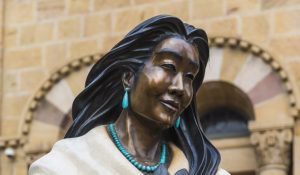
Soon after Wilma’s death of brain cancer in 1994, many strove to honor her memory. A new formitory at Tennesse State University was named after her, and the Governor named June 23rd “Wilma Rudolph Day”. Today the Women’s Sports Foundation presents the “Wilma Rudolph Courage Award” to female athletes who are courageous in overcoming adversity. And a beautiful life-size bronze statue of Wilma stands in the middle of her hometown of Clarksville.

“Never underestimate the power of dreams and the influence of the human spirit. We are all the same in this notion: The potential for greatness lives within each of us.”
Featured image of Wilma Rudolph courtesy Wikimedia Commons.
Recommended Reading


Keri is a blogger and digital marketing professional who founded Amazing Women In History in 2011.
Wilma Rudolph is very inspirational . She inspired me to run track and to not give up just because the person beside me was faster. because of Wilma i am now running the 2 mile run in a estimated time of about 10 minutes ! She probably could have did much better but i am proud of myself
That’s so awesome, Carolyn! Thanks so much for sharing your story. Wilma Rudolph is definitely one of the most inspiring women I’ve ever written about!
I remember the 1960 Olympics and remember Wilma Rudolph. I can still picture a TV interview of her after a winning race, still in her track shorts and shirt, by a male sportscaster in which he complimented her on having pretty legs. It was a real sign of the times. He meant it as a sincere compliment, and there was no commentary about whether he would have complimented a male athlete on having an attractive body. Remember: This was 1960. Rudolph smiled and accepted the compliment in the spirit offered, but I wondered at the time what she thought of it.
Thanks so much for sharing that memory, Hugh! Isn’t it amazing how much things have changed since then. The vast majority of people wouldn’t have given a second thought to a comment like that in 1960, but I’m sure today there’d be a backlash. It would be interesting to know how she felt about the focus on her legs rather than her skill and hard work.
A friend and I are doing a project on Wilma and we need to cite this website as one of our sources. Would you mind sharing what the copy right date is and what company owns this website? Thank you!
this site was very helpful for me to type my report
This was an interesting portrait of Wilma Rudolf, but I would have like to see more information about her accomplishments as an Activist. She was engaged in social activities against segregation and equality for female athletes. Her political activism tends to be excluded from her story, but was a very important part of who she was after the 1960 Olympics. You look at athletes like Serena Williams and you can map her notoriety to the pioneering activism of Wilma Rudolph.
Thank you for writing this. I am going to share it with my middle school students. It’s hard to find articles including her activism as well as her athletic achievements. This is super helpful!
Glad you found it useful, Sam!!