

Marital rape is committed when a person forces their spouse to take part in sexual acts without their consent. It is still rape if consent is obtained by coercion or out of fear. Though opinion polls reveal that many people consider marital rape to be less harmful than rape by a stranger, research shows the opposite is actually true. Because they are being betrayed by someone they trusted, women who experience marital rape often experience more and longer-lasting trauma than victims of stranger rape. Additionally, they often don’t consider what they experience to actually be rape, instead blaming themselves for being misleading or for not enjoying forced sex because it’s their “wifely duty.”
How common is marital rape?
According to surveys, 10 to 14 percent of women who have ever been married have experienced forced sexual assault by their husband or ex-husband. Women who experience marital rape are much more likely to have been assaulted more than once. At least a third of women surveyed who experienced marital rape reported it occurring over 20 times during the course of their relationship.
Research indicates that marital rape is actually twice as common as stranger rape, yet it receives far less public attention and legal focus. Among women who experience domestic violence, approximately one-third to one-half also report being sexually assaulted by their partner, demonstrating the overlap between physical abuse and sexual violence within marriages.
The historical roots of marital exemption

The legal foundation for marital rape exemption traces back to 17th-century English common law, which was imported to the British American colonies. The doctrine was most famously articulated by Sir Matthew Hale (1609-1676) in his legal treatise “The History of the Pleas of the Crown,” published posthumously in 1736. Hale wrote that “the husband cannot be guilty of a rape committed by himself upon his lawful wife, for by their mutual matrimonial consent and contract the wife hath given up herself in this kind unto her husband, which she cannot retract.”

This legal principle was based on the system of coverture, a legal doctrine under which a married woman’s legal rights were subsumed by those of her husband. Under this system, once unified by marriage, a spouse could no longer be charged with raping their spouse, any more than they could be charged with raping themselves. Early American colonies defined rape as “carnal knowledge of a woman 10 years or older, forcibly and against her will,” but this definition explicitly excluded wives.
The exclusion of married women from rape protections was further reinforced by laws that treated rape as property damage against a woman’s father or husband, rather than as a crime against the woman herself. This reflected the broader legal and social understanding that women were the property of men, first their fathers and then their husbands.
When was marital rape made illegal?
Throughout most of history, marital rape was not considered a crime. It was thought that when a woman married, she gave all authority over her body to her husband, and could no longer retract her consent. Usually laws defined rape as forced sexual intercourse by a male with a “female not his wife.”
With the advances in women’s rights that women fought for in the second wave of feminism, states began removing the marital exemptions from their rape laws in the 1970s. The first breakthrough came in 1974, when Michigan and Delaware partially outlawed marital rape, though they did not entirely eliminate spousal exceptions. Michigan criminalized marital rape only when a couple had filed for divorce and were living apart, while Delaware treated rape of a “voluntary social companion” (which could include a wife) as a lesser crime than other forms of rape.

The first states to completely outlaw marital rape were South Dakota and Nebraska in 1975. In South Dakota, a bill introduced by Senator Grace Mickelson quietly struck the spousal exemption from state law, though the exception was restored not long afterward. Nebraska’s change was more lasting—the state modernized its law to use the term “sexual assault” rather than “rape” and made it gender neutral. This change resulted from advocacy by second-wave feminist organizations and victim advocacy groups, and was introduced to the legislature by Senator Wally Barnett.
The landmark legal case that brought national attention to marital rape was Oregon v. Rideout in 1978. This was the first case in the United States where a man was charged with raping his wife while they were still living together. Although the husband was acquitted, the trial spurred reform movements across the country, and many American states began allowing prosecution for marital rape.
A crucial legal precedent was set in 1984 with the New York Court of Appeals case People v. Liberta. Judge Sol Wachtler stated that “a marriage license should not be viewed as a license for a husband to forcibly rape his wife with impunity. A married woman has the same right to control her own body as does an unmarried woman.”
By 1993, North Carolina became the last state to remove the exemption and make marital rape illegal. However, Oklahoma also eliminated its marital rape exemption in the same year, marking the completion of legal reform across all 50 states.
Is marital rape illegal in the United States today?
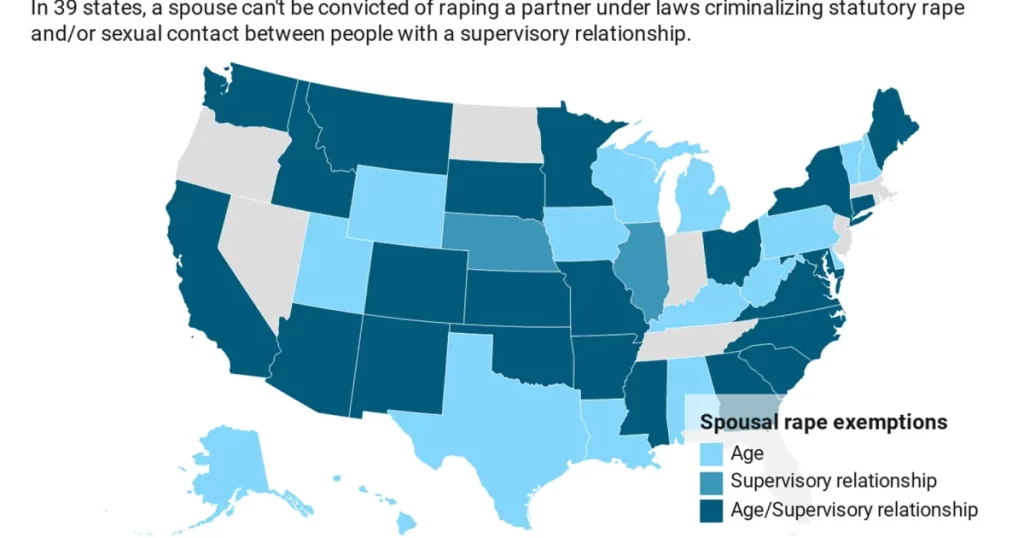
Marital rape is now illegal in all 50 states. However, it is still treated differently than stranger rape in many states. For example, a husband is still exempt from prosecution in several states if he rapes his wife while she is mentally or physically impaired, unconscious, or asleep. Many states also have shorter reporting periods and less jail time for a man who rapes his wife as opposed to a stranger.
As of recent analyses, approximately 30 states still provide some exemptions for husbands from rape prosecution. In most of these states, a husband is exempt when he does not have to use force because his wife is most vulnerable—when she is mentally or physically impaired, unconscious, asleep, or otherwise unable to consent. Only 20 states, the District of Columbia, and federal lands have no exemptions from rape prosecution granted to husbands.
Some states continue to impose different standards for marital rape cases. For example, South Carolina treats marital rape as a “lesser crime” than non-spousal rape, with perpetrators facing up to 20 years less prison time than they would for raping a non-spouse. The state also requires that spousal sexual battery be reported to law enforcement within 30 days of the incident, a requirement not imposed on other rape cases. Virginia allows courts to defer prosecution and waive fines and prison time if the defendant-spouse successfully completes a court-approved counseling program.
Recent reforms and ongoing challenges
Legal reforms have continued into the 21st century. Minnesota eliminated its marital rape exception in 2019 when Governor Tim Walz signed legislation ending protections for rapists who still lived with and had sexual relations with a spouse. California and Idaho repealed their provisions for marital rape in 2021. These reforms were often driven by survivors’ advocacy, such as Jenny Teeson in Minnesota, who discovered the legal loophole when she reported her own case to law enforcement.
Despite legal progress, significant challenges remain in prosecuting marital rape cases. The crime is severely underreported, with victims often failing to recognize the assault as rape due to deeply ingrained cultural beliefs about marital duty and consent within marriage. Many victims blame themselves or feel that forced sex is part of their obligation as wives.
When cases are reported, they face unique prosecutorial challenges. The intimate relationship between victim and perpetrator complicates evidence gathering and prosecution, particularly when the couple continues to live together. Cultural and legal attitudes that view marital rape as less serious than stranger rape persist, affecting how cases are handled by law enforcement, prosecutors, and juries.
The ongoing impact and global context
The physical and psychological consequences of marital rape are severe and often more traumatic than stranger rape. Victims experience not only the trauma of sexual assault but also the betrayal by their life partner. Physical effects include injuries to genital and anal areas, sexually transmitted diseases, unwanted pregnancies, and gynecological problems. Psychological effects include post-traumatic stress disorder, depression, anxiety, and long-term intimacy problems.
Globally, marital rape has been criminalized by approximately 150 countries as of 2019, representing significant progress in women’s rights. However, many countries still do not recognize marital rape as a crime, particularly in more conservative cultures where traditional views of marriage and women’s roles persist. In some countries, cultural and religious interpretations continue to view sexual access as a fundamental right of marriage.
The United States’ journey toward criminalizing marital rape reflects broader changes in understanding women’s rights, bodily autonomy, and the nature of consent. While legal protections now exist nationwide, the persistence of different standards and exemptions in many states demonstrates that full equality in rape law remains an ongoing challenge.
The evolution of marital rape law represents a significant shift from viewing wives as property to recognizing them as individuals with the right to bodily autonomy and sexual self-determination. However, the continued differences in how marital rape is prosecuted compared to other forms of rape indicates that this legal and cultural transformation is still incomplete.
Citations
- Bergen, R. K., & Bukovec, P. (2006). Men and intimate partner rape: Characteristics of men who sexually abuse their partner. Journal of Interpersonal Violence.
- Ferro, C., Cermele, J., & Saltzman, A. (2008). Current perceptions of marital rape: Some good and not-so-good news. Journal of Interpersonal Violence.
- Finkelhor, D., & Yllo, K. (1985). License to rape: Sexual abuse of wives. Holt, Rinehart and Winston.
- Hale, M. (1736). The History of the Pleas of the Crown. Published posthumously.
- Martin, E. K., Taft, C. T., & Resick, P. A. (2007). A review of marital rape. Aggression and Violent Behavior.
- National Coalition Against Domestic Violence. (2015). Domestic violence national statistics.
- Oregon v. Rideout, 1978. First marital rape prosecution case in the United States.
- People v. Liberta, 1984. New York Court of Appeals decision establishing precedent for marital rape prosecution.
- Russell, D. E. H. (1990). Rape in marriage. Indiana University Press.
- U.S. Department of Justice, Office of Justice Programs. (1998). Marital rape: History, research, and practice.
- Violence Against Women Act (VAWA), 1994. Federal legislation addressing domestic violence and sexual assault.
- World Population Review. (2025). Marital rape states 2025. Retrieved from https://worldpopulationreview.com/state-rankings/marital-rape-states
- National Intimate Partner and Sexual Violence Survey (NISVS). Centers for Disease Control and Prevention.
- UN Women. (2019). Facts and figures: Ending violence against women. Retrieved from https://www.unwomen.org/en/what-we-do/ending-violence-against-women/facts-and-figures
- Bierschbach, B. (2019). “This Woman Fought To End Minnesota’s ‘Marital Rape’ Exception, And Won.” NPR.
- Pirius, R. (2022). “Marital Rape Laws.” Mitchell Hamline School of Law. Retrieved from https://www.criminaldefenselawyer.com/marital-rape-laws.html

Keri is a blogger and digital marketing professional who founded Amazing Women In History in 2011.

Leave a Reply