
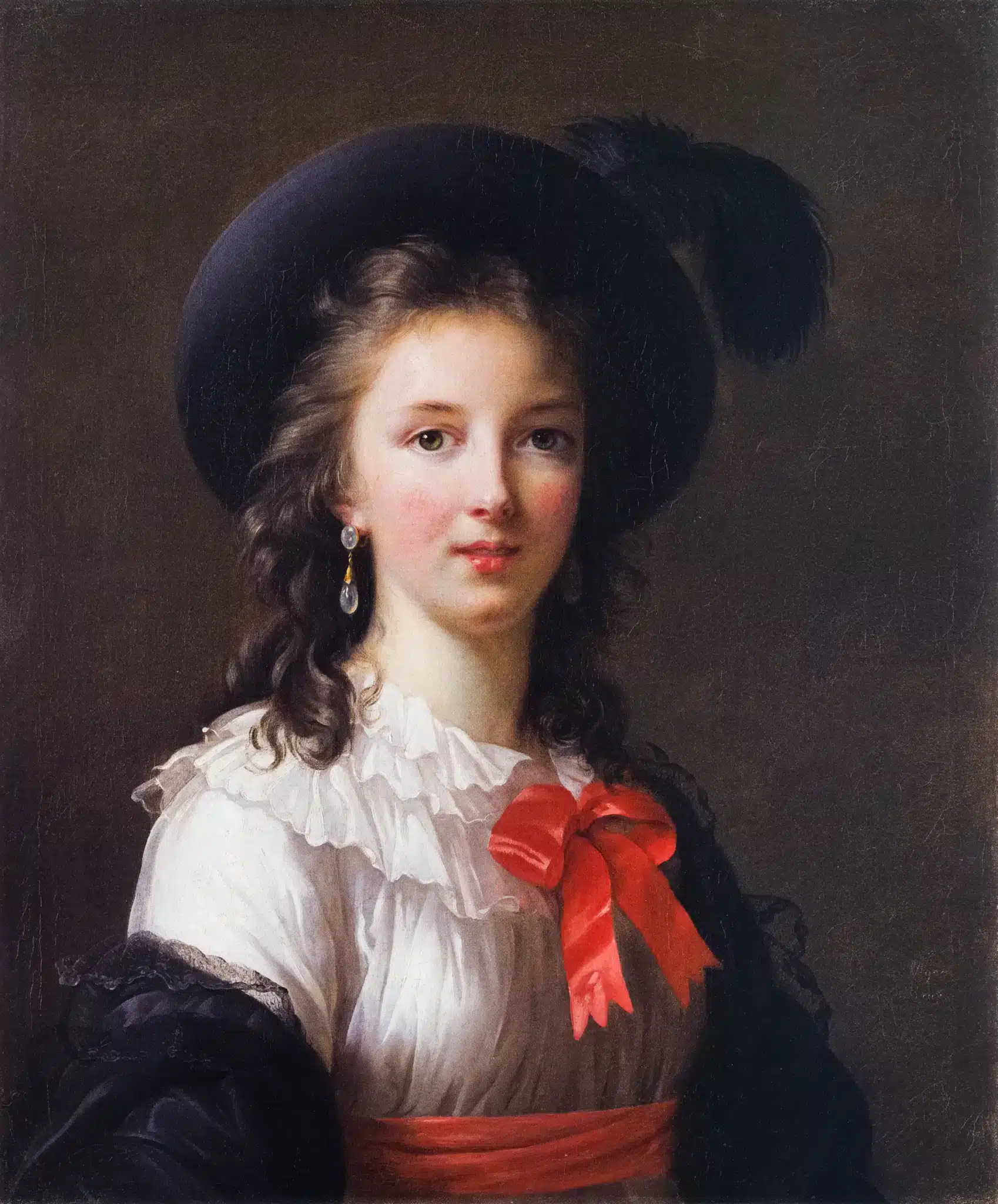
A few years ago, New York’s Metropolitan Museum of Art held a retrospective of Louise-Élisabeth Vigée Le Brun’s oeuvre. Reviewers gave the exhibit so much praise that, despite never having heard of the artist, I went to see it. Vigée Le Brun’s paintings were riveting, her brief introductory biography intriguing. This unusual woman, I vowed to myself, would be the subject of my next book.

Vigée Le Brun was famous as a portraitist throughout late eighteenth- and early nineteenth-century Europe. Her paintings today hang in the world’s foremost museums, despite her gender having prevented, in her lifetime, the ultimate in professional recognition—an official designation as history painter.
Vigée Le Brun never allowed her femininity to block her childhood ambition to be a great painter. Born (1755) into the Paris bourgeoisie before France ever thought of beheading its king, she died (1842) under her country’s first truly constitutional monarchy. Vigée Le Brun experienced the fall of France’s Old Régime and the creation of modern France, to say nothing of the turmoil that shook the continent of Europe for over twenty years, but from a unique viewpoint, Vigée Le Brun painted most of the major players.
She immortalized the men who tried to rescue the French monarchy: pro- and anti-revolutionary European nobles; illustrious artists, musicians, and poets. And rather than merely portraying as pretty puppets the women who decorated Versailles, Vigée Le Brun depicted these beautiful, aristocratic women who personified pre-revolutionary France as vibrant human beings.
* * *
Louise-Élisabeth Vigée’s brilliant use of color, dramatic style, and perceptive poses made the talented teenager a sought-after portraitist, despite her gender having barred her from the traditional art education open to every aspiring male artist. Within a few years, Louise-Élisabeth had gained enough status to paint Queen Marie-Antoinette. The queen soon favored her over all other artists.
Louise-Élisabeth wed a prominent art dealer at age twenty to escape an unhappy home, but her marriage turned out to be unsatisfactory. “Not because M. Le Brun was a bad man; his nature showed a great mixture of sweetness and vivacity; he treated everyone very kindly; in short, a very likable person. But his reckless passion for women of ill repute, combined with his lust for gambling, resulted in the loss of his fortune and mine, which he fully controlled.”
Vigée Le Brun’s pretty face, her attractive figure and sense of fashion, her charm and gift for making friends, and—above all—her talent and determination to succeed propelled the young painter into the top echelons of scintillating Old Régime society. Her subsequent status as a leading portraitist of late eighteenth- and early nineteenth-century French and European aristocracy brought Vigée Le Brun a recognition rare among history’s handful of female artists.
Her success in carrying the genre of portraiture to unparalleled peaks left posterity a vivid picture of an exciting and vital time in Western history, a time when Europe stood on the cusp of the modern era. That achievement distinguishes Vigée Le Brun not only for the historical connection that gives many of her portraits particular importance but also for her talent, which ensures the most illustrious of her creations a prominent place in any premier painting collection.
Engrossing new biography provides a fresh perspective on an overlooked French portraitist

The latest biography from historian Judith Lissauer Cromwell follows the remarkable life of Louise-Élisabeth Vigée Le Brun, whose portraits of European royalty and nobility hang in many of the world’s most important galleries. As a young woman in the male dominated society of 18th century France, she was denied an artistic education and forced to nurture her passion outside of conventional schooling. Vigée Le Brun’s vibrant art, in addition to her charm and beauty, caught the attention of Queen Marie-Antoinette, who honored her as her chosen painter. At the pinnacle of her fame and fortune, however, the Revolution forced Vigée Le Brun to flee, leaving everything behind except her only child.
Drawn from Vigée Le Brun’s memoirs, archival research, and reexamination of the judgment of her contemporaries, this biography paints a fascinating picture of a single working mother who survived because of her cachet, charisma, and artistic talent. Cast on a storm-tossed continent, solely reliant on her palette, she produced some of her major works during her twelve-year exile, returning to France to continue her work after Napoleon had restored stability. Vigée Le Brun’s story is one of triumph, adversity, perseverance and ultimately, peace.
About the Author, Judith Lissauer Cromwell

After a successful corporate career, Judith returned to academia as an independent historian and biographer of powerful women. Her experience as a magna cum laude graduate of Smith College, holder of a doctorate in modern European history with academic distinction from New York University, veteran of corporate America, mother, and grandmother, enrich Cromwell’s perspective on strong women in history.
The daughter of a pioneering female physician, one of a handful admitted to the staff of New York Hospital in the early 1950s, Cromwell entered the international world of Wall Street in 1973 as one of its few female executives. During her twenty year career, she established a global firm’s company-wide information center, then founded the firm’s market research department where she organized, executed, and presented strategic planning projects. She not only thrived in the clubby male world of Wall Street, but also, as a single working parent, raised two children. Judith was elected a member of the YWCA Academy of Women Achievers.
She is the author of the biographies “Dorothea Lieven: A Russian Princess in London and Paris 1785-1857,” “Florence Nightingale, Feminist,” and “Good Queen Anne: Appraising the Life and Reign of the Last Stuart Monarch.” Her latest biography, “Louise-Élisabeth Vigée Le Brun: Portrait of an Artist, 1755-1842” provides a fresh and balanced perspective on the life of a renowned, yet often overlooked, painter.
Learn more about Judith’s work at: www.judithcromwell.com

Keri is a blogger and digital marketing professional who founded Amazing Women In History in 2011.
Beyond the article
Join the Conversation
Share your perspective, ask a question, or add something to the story.