
Ever wondered why a married woman can be addressed by her husband’s name? Why is it “Mr. and Mrs. Husband’s Name” and never the other way around?
The tradition of calling a woman by her husband’s name comes from an old legal practice that erased a woman’s identity, called “coverture.”
The law of coverture is no longer around, but we can still see its effects today.
What Is Coverture?
Coverture was a set of laws that said that a married woman’s identity was “covered” by her husband’s.
Under the law of coverture, a woman’s legal rights were subsumed by her husband’s when she got marriage.
Legally, a husband and wife became one person: the husband. Upon marriage, the wife gave up her separate identity under the law, and her husband in effect had complete legal and economic control over her.
When did the doctrine of coverture originate?
It all started in the Middle Ages.
England in the Middle Ages used a system of “common law.” The law wasn’t all written down in one place. Instead, laws were developed over time through the court decisions of judges.
It was under this system that the doctrine of coverture developed between the years 1000 to 1500, and was eventually brought to the English colonies, including the United States. An English judge named William Blackstone wrote an overview of English law called “Commentaries on the Laws of England” in the 18th century, which gave the first complete written description of the system of coverture.
How did coverture affect married women’s rights?
Under coverture, the status of married women was called “feme covert,” which literally meant “covered woman.” Her legal identity and rights were covered by her husband’s, and her own legal identity was nonexistent.
Because she was not a person legally, she could not…
- own any property (including the clothes on her back)
- own or control her own body
- make decisions for her children against her husband’s wishes
- sign legal documents or enter into contracts
- keep her own salary
- get any education against her husband’s wishes
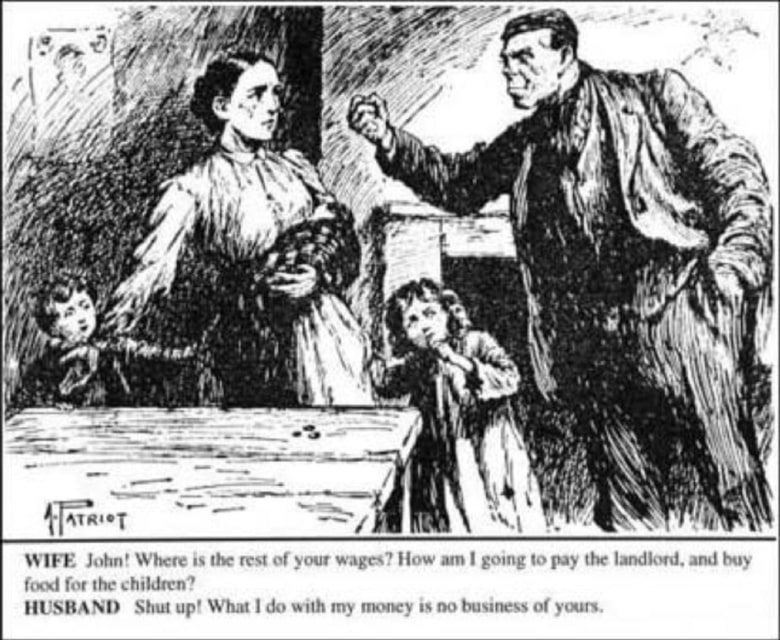
A “feme covert” also had no legal rights over her own body or her children. In practice, a married woman might run a business with her husband, or have to take over running the household while her husband was away.
However, everything she did legally had to be in her husband’s name, since she was a non-person under the law.
Were single women affected by the doctrine of coverture?
Under the doctrine of coverture, an unmarried adult woman’s status was called “feme sole.” She would be recognized as an individual person under the law, and would be able to own property and sign contracts in her own name.
When did coverture end?
There was no official end to the doctrine of coverture; instead, the laws were slowly eroded away by the passing of women’s property acts beginning in the mid-19th century.
In the United States, many laws were enacted gradually by the different states that enabled women to own and control property, sign contracts, inherit separately from their husbands, keep their own salaries, and write their own wills. These laws were motivated not by any feminist movement, but by the economic needs of men. Under the new laws, a husband would be able to move money and property into his wife’s name, protecting his assets from debt collectors and bankruptcy.
Though the doctrine of coverture that was practiced for centuries no longer exists today, its effects can still be seen on some of our modern laws and culture.
For example, it was due to the influence of coverture that marital rape wasn’t a crime until the 1970s. After how, how could it be rape if your wife is your property?
Women also couldn’t get their own mortgages or open bank accounts without the bank asking their husband for permission until very recently.
“Mrs. John Smith” is called by her husband’s name because her legal identity was literally subsumed by her husband’s upon marriage. It’s important to understand where these traditions come from so that we can continue to move towards treating women and men equally under the law.
Next, read about how women won the right to own property, or discover the story of Amelia Bloomer: Temperance, Suffrage, and Rational Dress Advocate.

Keri is a blogger and digital marketing professional who founded Amazing Women In History in 2011.
This site is amazing Keri, I was just doing some research for my future book searching for more information on the first female doctor Elizabeth Blackwell when I found a link to this web site. I signed up for the newsletter and will enjoy reading whatever you have gleaned from your own research concerning Kick-Ass Women history has forgotten to leave truth in print for us to learn and feel proud to stand up, to embrace these women. I have been searching for the truth regarding everything that has oppressed women down through the ages, what I have discovered is that most of the bondage that women find themselves enslaved to was created by man. My book will be for women who are open-minded, free thinkers that perhaps one of their friends who are locked in a marriage that has violence and she wonders if she will ever be free to find out who she is and what adventures still are waiting for her, this is why I write. We as women were created to be bold and strong. bossy independents, able to learn how to protect ourselves whether physically or verbally not to depend on men to protect us because they follow an oppressive, filled with lies, stories that never happened, a book called, The Christian Bible. I know because I have lived under that book’s teachings for nearly 50 years until a few years ago.
Preach, Dee!!! Thanks so much for your kind words. I’m so glad you’ve found inspiration here. Please get in touch with me when your book is released and I’d be happy to help you promote it 🙂
Thanks so much for this piece, I found it truely amazing and inspiring.
Great write out!
Thanks so much, Dee!
An example of how coverture worked in textile mills in the southern US. The mills would employ entire families including children who were big enough to do any kind of mill work. All of the wages were paid to the head of the household. When my maternal grandparents married in 1906, Mama Bailey had to show her marriage certificate to the paymaster at the cotton mill in Porterdale GA so he would stop giving her pay to her stepfather and start giving it to her husband. Nobody ever thought of giving it to her.
Wow!! Thanks so much for sharing that bit of real history Lamar.
Loved the history on this outdated tradition! I frequently ask people why they take the mans name, and they say “that’s just what you do” or “its tradition” for which I retort “buy why?” and they’re actually dumbfounded, it has never occurred to most people that to take a mans name was somehow a strange and unequal behaviour until someone asks them ‘why did you take a man’s name?’
Great stuff!
Thank you Tiarne!
Super informative — inspired me to fully delve into some books on feminism.
Thanks!