
Harriet Powers (1837-1911) was a super creative, African-American quilting genius! She used her quilts to re-tell familiar Bible stories in a unique and fascinating way. At least two of these story quilts have survived and are on display in American museums.
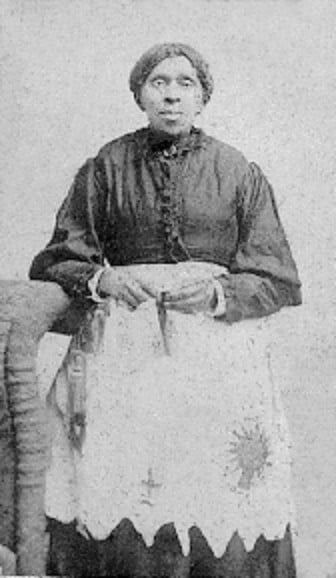
Harriet Powers was born into slavery in rural Clarke County, Georgia, where she lived on a plantation owned by John and Nancy Lester. Details regarding her childhood and life as a young adult are lacking. However, we know that in 1855, she married Armstead Powers, who described himself as a “farmhand” in the census of 1870, and that she raised at least nine children.
After the end of the Civil War, Powers and her husband owned a small farm, but were always facing financial difficulties and had to sell off parts of their land. After 1895, when her husband left her, she most likely supported herself and her family by working as a seamstress.
But Powers was also an incredible artist who used applique and piecework techniques to weave scenes of Biblical and celestial themes into her quilt designs. These quilts implement layers of storytelling strategies to effectively illustrate various Bible stories, particularly those from the Old Testament. Each panel of her quilts tells a different story in a colorful, symbolic, and highly unusual way.
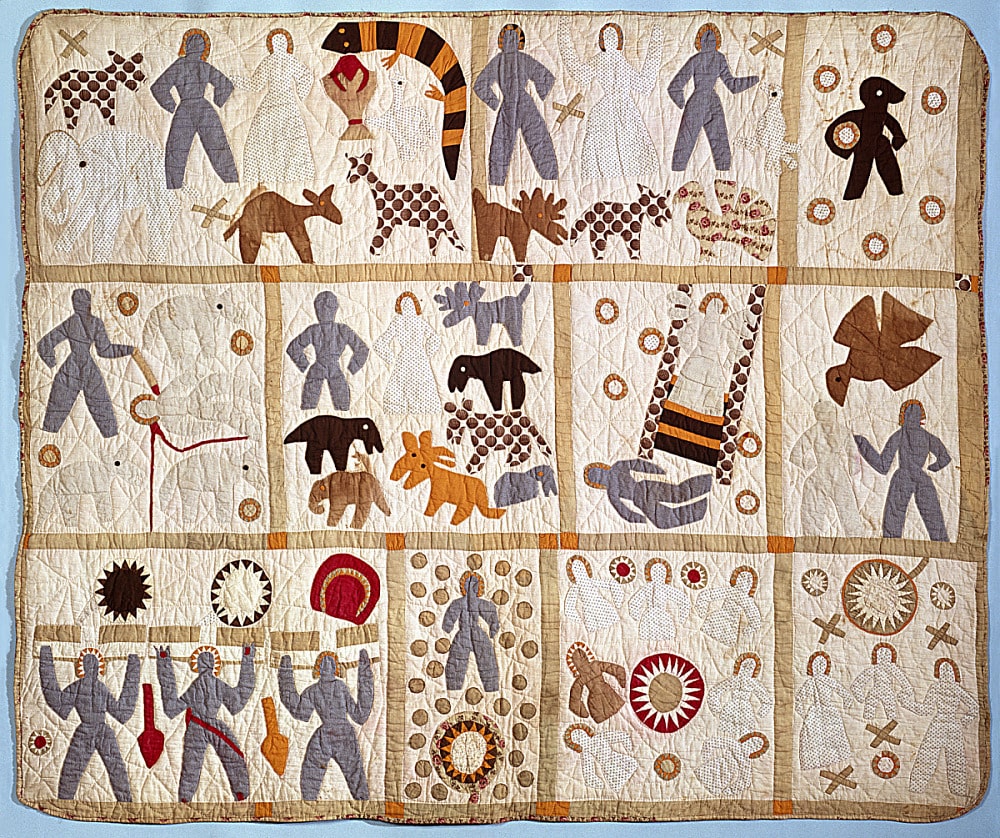
In addition to the Biblical influences, she included astronomical bodies in her quilts. These included the sun (African symbol of circularity and the omniscience of God) and astronomical events, such as the Leonid meteor shower that occurred in 1833.
This is part of what makes her artwork so unique and interesting – the connections to African-American folk history and to West African tapestries, traditionally made using applique techniques. It seems very believable that Powers could have been inspired by a West African heritage passed down to her from her mother or other African-American women.
It is thought that Powers may have made as many as four story quilts, but to-date only two have been located and identified as hers. Her first quilt (known as Bible Quilt 1886) was shown at the Athens Cotton Fair in 1886. It came to the attention of Jenny Smith, who indicated that she was interested in buying it. In 1891, when her family was experiencing another time of great financial need, Powers did sell the quilt to Smith. And she included with it an explanation for the vivid imagery she had woven into it. We know that she kept in touch with Smith and visited with her a few times to see the quilt. Bible Quilt 1886 is on display at the National Museum of American History in Washington, D.C.
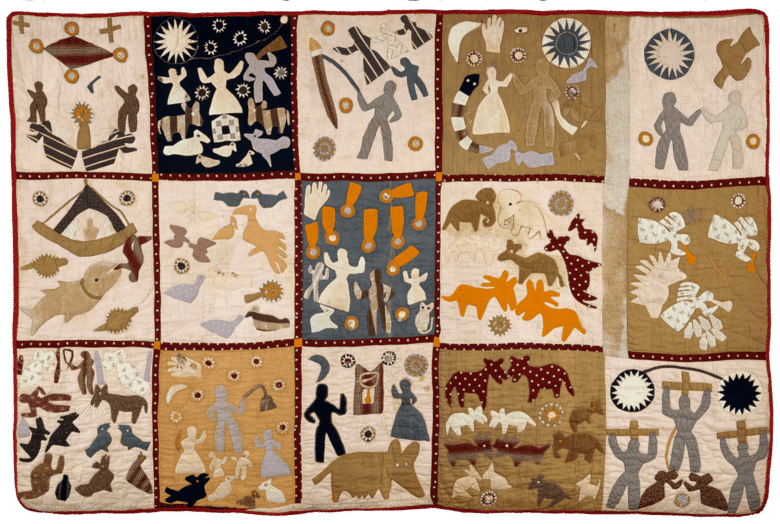
In 1895, Smith exhibited Bible Quilt 1886 at the Cotton States and International Exposition in Atlanta. It has been suggested that a group of faculty women at Atlanta University may have seen it and commissioned Powers to make a second quilt. Another theory is that these faculty women purchased it in Nashville, TN. This quilt (known as Pictorial Quilt 1898) is now on exhibit in the Museum of Fine Arts in Boston, MA.
In addition to Jenny Smith’s diary and notes and the quilts themselves, there are a few other historical texts regarding Harriet Powers. One of those is an article by Lucine Finch that was published in Outlook Magazine in October 1914. It is unclear when Finch may have interviewed Powers or why she waited 3 years after the death of Powers to publish it.
Like Smith, Finch was an unmarried, white Southern woman with a strong interest in art. She did not name Powers in the article as the artist, but wrote:
“[The quilt] is the work of an aged Negro woman, who put into it the reverence, the fantastic conception of sacred events, and the passion of imagination of her people.”
Lucine Finch
Like many Americans from that time period, she spoke of Powers in a condescending way, although at the same time, she was clearly captivated by the Bible quilts. Using dialect, a common way at the time to record the speech of African-Americans, she quoted Powers as saying that she made these quilts to “preach de Gospel in patchwork, ter show my Lawd my humbility.” Nevertheless, Finch also describes the quilts as “the reverent, worshipful embodiment of an old colored woman’s soul.” And fortunately for us, she went on to capture the words of Harriet Powers, as she describes each of the eleven panels on Bible Quilt 1886.
Other than the quilts themselves as primary sacred texts, we may never know more details of the religious and spiritual life of Harriet Powers. However, maybe she did use these quilts to preach the Gospel to her community. The dimensions of the two quilts are not the standard size of a bed, so it is not an unreasonable theory. And perhaps Harriet Powers is still preaching the Gospel in patchwork, continuing to tell the sacred stories through the spiritual presence of these two beautiful Bible quilts.
- Reference 1: Finch, Lucine, “A Sermon in Patchwork,” Singular Women: Writing the Artist,” Frederickson and Webb, eds., University of California, Berkeley, CA, 2003. Originally published in Outlook Magazine, October 28, 1914.
- Reference 2: Fry, Gladys-Marie, “A Sermon in Patchwork: New Light on Harriet Powers,” Singular Women: Writing the Artist,” Frederickson and Webb, eds., University of California, Berkeley, CA, 2003.
- Reference 3: Richardson, Jan, “In the Sanctuary of Women: A Companion for Reflection & Prayer,” Upper Room Books, Nashville, TN, 2010.
- Photo credits: Wikimedia Commons – public domain.
Julie Henkener is an engineer at NASA Johnson Space Center. In her spare time, she is writing a book that pairs quotes from spiritual women with her own original artwork for meditation. You can find her blog at www.juliehenkener.com.
Love this article, her quilts are amazing!