
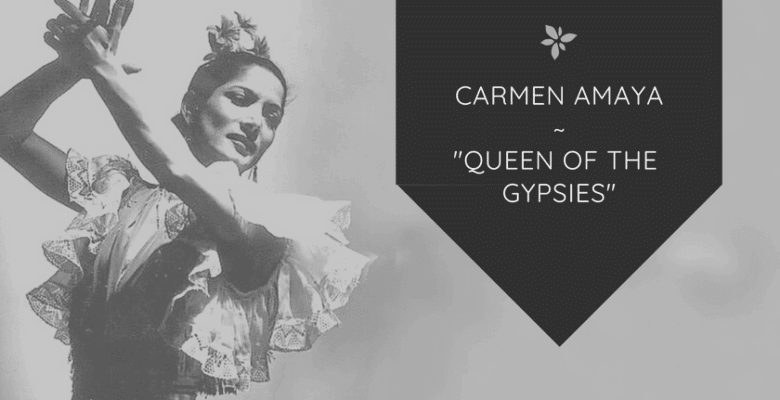
Carmen Amaya (1913–1963) was a Romani dancer who performed around the world and had a huge impact on the art of flamenco. During her lifetime she was called the greatest of dancers, and Queen of the Gypsies.
Carmen Amaya is hail on a windowpane, a swallow’s cry, a black cigar smoked by a dreamer, thunderous applause; when she and her family sweep into town, they cause ugliness, torpor and gloom to evaporate just as a swarm of insects strips the trees of their leaves.
Jean Cocteau (1889–1963)
Carmen called herself a Gypsy, but today this term is considered offensive by many Romani people for its negative history and connotations. She was what we would now call Romani, or more specifically, Calé. (They are also called Gitano, which is Castilian Spanish for “Gypsy”.) The Calé are a Romani-descended people in the Andalusian region of Spain, who long ago emigrated from Northern Indian. Their culture and music greatly influenced the entire region.
Flamenco music grew out of Andalusia, and there is some controversy regarding its exact origins and various influences (even the etymology of the word “flamenco” is unknown for certain), but there is no doubt that it grew with the local Romani people at the helm. Though flamenco is at the heart of Romani culture, it is also a mixture of Indian, Persian, Greek, Moorish, and Arabic elements.
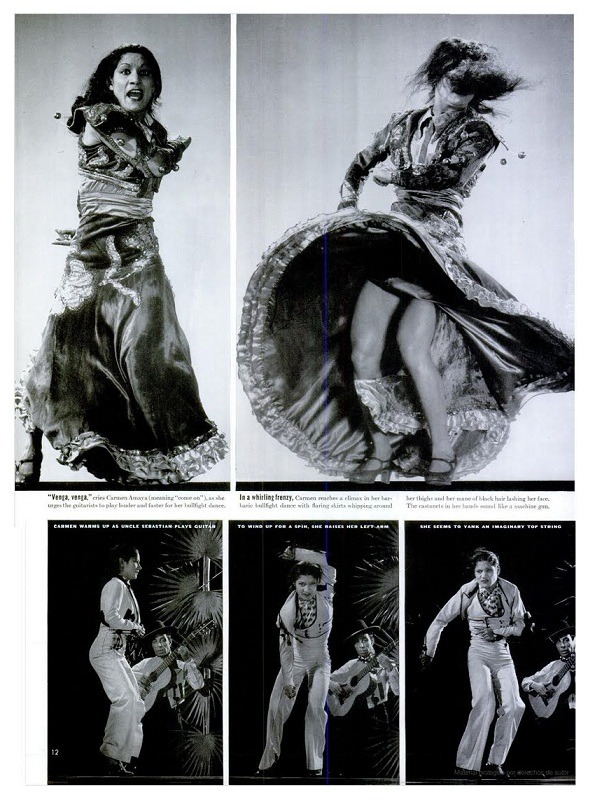
Flamenco is known for its energetic, staccato style, and as a cultural art it has many parallels to American blues. As a people the Romani had been oppressed and abused for hundreds of years. Flamenco emerged as a very private and ritualistic dance, performed with hand clapping because they could not afford musical instruments.
In Spanish culture and especially in Flamenco there is a word called duende, usually translated as spirit, soul, or fire. It is a difficult concept to translate but it is meant to convey the heart, soul, and emotion of flamenco. Different styles of flamenco dancing convey different emotions, but they all have duende. As a folk music, flamenco embodies the hopes, joys, and sorrows of the Romani people, and expressing this in dance is duende.
Carmen was said to have great duende in her dance. In the videos of her dancing, you can see the trance-like look on her face and the great emotion she expressed in her dance:
“I saw her dance and it seemed like something supernatural to me… I never saw anyone dance like her. I don’t know how she did it, I just don’t know!”
Sabicas (Agustín Castellón Campos)
Carmen forever changed the art of flamenco with her dancing. Though she never studied dance formally, she started dancing at a very young age, travelling around to taverns and halls and performing with her father. By her teens she was known around Spain and as far as Paris. In the 1930s, Carmen began to travel the world, and became famous especially in the Americas, mesmerizing audiences from Argentina, Brazil, Cuba, to Mexico and the United States, where she danced in several films. She was invited by Franklin Roosevelt to dance in the White House in 1944, and also by Harry Truman in 1953.
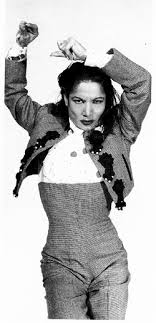
A pioneer in flamenco, Carmen combined traditionally feminine and masculine flamenco dance into her own unique style. Her heavy, stomping, lightning-fast footwork had been reserved for male flamenco dancers before, but she combined her intricate footwork with a feminine grace and style. She often danced in matador pants- in fact, she preferred the pants and jacket to a dress. She made shockwaves with her unusually passionate and fiery dance while wearing traditionally masculine clothing, but today these styles are taken for granted in flamenco.
“Rhythm, sensuality, drama were part of her arsenal of magic. Serious, sultry and unpredictable, she commanded instant attention. Alternately appearing in flamboyant gowns and her preferred tight matador pants, she exuded the pansexual, virtually demonic charisma of a rock star. Her lightning footwork, faster than the eye could comprehend, made audiences dizzy”.
Conductor Arturo Toscanini (1867–1957)
“She was from the race of the rebels, of those people who stray from the beaten track and ordinary rules, who only show that there is suffering in their dancing, like there is suffering in existence, and a rage for living. It is a dance that is marked by fire, whose thirst could only be quenched through death”.
Patrick Bensard, director and founder of the Cinémathèque of Dance in the French Cinémathèque

Keri is a blogger and digital marketing professional who founded Amazing Women In History in 2011.

Thank you Keri! Thank you so much for introducing me to Carmen Amaya. I’ve been trying so hard to get back to my roots. Watching her put a fire in me that is both riveting and comforting. THE BEST.
Isn’t she amazing? There’s so much raw passion in her dance- watching her helped me understand what “duende” really means.
Paola is right on it of course, but Duende’s closest English translation is the magical spirit or atmosphere an event or performance can evoke, and can be tempered by its own descriptive adverbs Alegrias Joyful, or Hondo (Jondo) Deep or non existent for instance. So if “you” feel it, no one can really argue with you, but it is a kind majority rules shared experience kind of deal if you get me LOL. And yes Carmen was wonderful and a living legend. A near Saint in Barcelona. She’s “the” Bailaora (same root as the word Ballet) of the 20 century. The person calling the her “a dude” got under my skin a little, sorry. The offender would get lynched in Catalonia.
It’s also probably more polite to them the Cale peoples (with a dash over the E like in cafe) as its more polite than Rom and not as general.
Magnificent people as reflected in their art. Flamenco is one of the Highest art achievements of human potential and she was the undisputed Queen.
Lola Flores is worth you gals having look at too if your interested in great women along these lines.
Thanks Cru, this is super interesting!
BTW I deleted that comment you referenced, it shouldn’t have been approved – no need to be sorry, just a troll.
Will look into Lola Flores 🙂
Thank you for this.
It was hard for me to explain the questions of race in this part of the world when I was hanging out on some North American message boards… This could help a bit to spread the awareness of the existence of Roma(ni).
And her movements were lightning-fast 😮 !
Americans particularly are notoriously touchy about race (I say this as a USian myself). It’s a difficult topic to talk about when everyone gets defensive. I found the comparison of Flamenco music and dancing to the Blues tradition in the US to be very enlightening.
I admit I don’t know much about it, but from what I do know it seems that (at least in the US) Romani are often looked at as a relic, a race assumed to be extinct or assimilated, much like Native Americans are assumed to be. Though they both have fascinating, beautiful, and powerfully resilient cultures that exist and thrive to this day!
I loved watching Carmen dance in the video & I’m going to try to include videos in the posts from now on, when I can find good applicable ones 🙂
No, not extinct.
I got the touchy part.
It started getting interesting for me when someone linked to a comparison of what is considered ‘race’ in different countries – something that is white in the US is non-white elsewhere, and something that is white elsewhere becomes non-white in the US and gets all the privilege that come with it or loses the privilege it had (+ there was a bit about what was considered non-white earlier in the US history vs. what is considered as such now).
… And Roma(ni) fell neatly there.
Considering that there were some really awful laws being put into practice in some parts of Central Europe at that moment and with all the hateful ‘jokes’ that you can hear in Europe, it was strange hearing they were white in the US (although, that might have come from the confusion stemming from the fact that Gypsy can both mean Romani and gypsy: “a nomad, in general”, aided by the fact that there are subgroups within the Romani – Bob Hoskins and Charlie Chaplin being descendants of a branch).
Ack, it’s hard talking about it in a language that’s not my own and trying to get all the complex info in a few sentences, but I just wanted to say that they are here and visible.
[/end]
FYI
Flamenco did not ’emerge’ with dance but with cante (singing) and the rhythmic beat of the hand – like the rapping of knuckles on a table. Then came the palmas and guitar. The improvised dance emerged around 200 years later and certainly brought a new spirit and impassioned presence to the music.
As for duende,…
Duende is not always present nor can it always be invoked. Each of the styles has the possibility of duende but the depth of duende is elusive, momentary and rare, especially in the current rage of staged flamenco. Yes, Carmen Amaya had a beauty, style and passion in her dance that brought about more possibility of duende, But, duende comes not only from the flamencos but also from the audience. The energy swirls and there is play and inspiration back and forth between the musicians and dancer(s) with the audience that can invoke the feeling of duende – one inspires the other.. But it is by no means always present nor can it be consciously invoked. Just like you can’t pick who you love, you cannot pick or predict a moment of duende. And therein lies much of the beauty that flamenco holds…the longing and reaching for that feeling, the moment of piercing joy.
Beautiful explanation, Paola! Thanks so much for expanding on Flamenco & duende 🙂
La Palmas, Clapping, Golpe Tapping, Canteor Singer, Carmen Amaya & Rafael Romero, Cale Royalty.
Paolo, that is exactly it! You captured everything I was feeling throughout reading this piece. Keri, than k you for bringing Carmen Ayala to the light for those who don’t know much about her or Flamenco.
No that was the Queen of Duende. Say that in Catalonia in front of any Cale person Tocaor or Bailaor and they’ll ream you a new one buddy, and I mean sought it right out for you.
Hey Keri,
Great post, must add however, that at the risk of sounding touchy, not mentioning the Sefardi (Sephardi) in this sentence “Though flamenco is at the heart of Romani culture, it is also a mixture of Indian, Persian, Greek, Moorish, and Arabic elements” is a disservice to flamenco.
It was the expulsion of the Jews from Spain in 1492 that was the catalyst for why these persecuted cultures including Roma/ Sinti came together in secrecy . Lorca also, talks vividly that cante jondo evolved from the ritual of the Sephardim (see his book Poema del Cante Jondo) and Paco de Lucia in an interview states there is so much Jewish culture in flamenco that we do not know about yet, meaning has not been uncovered and researched properly.
I hope you can consider including this important culture within flamenco’s history and elemental sources in your writing.
cheers Annalouise