
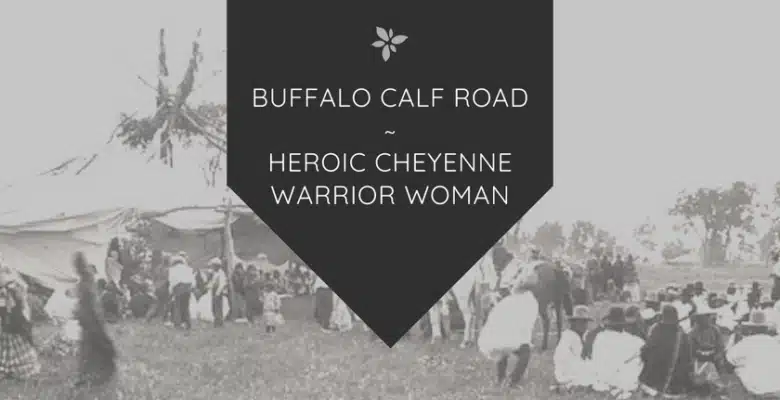
The remarkable story of a young Cheyenne warrior woman in her early twenties, Buffalo Calf Road, spans a period of 3 years from 1876 until her death in 1879. During this time the Cheyenne were caught in the westward expansion of pioneers, miners and the army, all determined to colonize the land on the great plains occupied by native peoples. The Cheyenne and other native tribes endured attacks, massacres and forced removals to reservations.

It is not known how she acquired her skill with a gun, but Buffalo Calf Road first rose to prominence among her people at the Battle of the Rosebud.
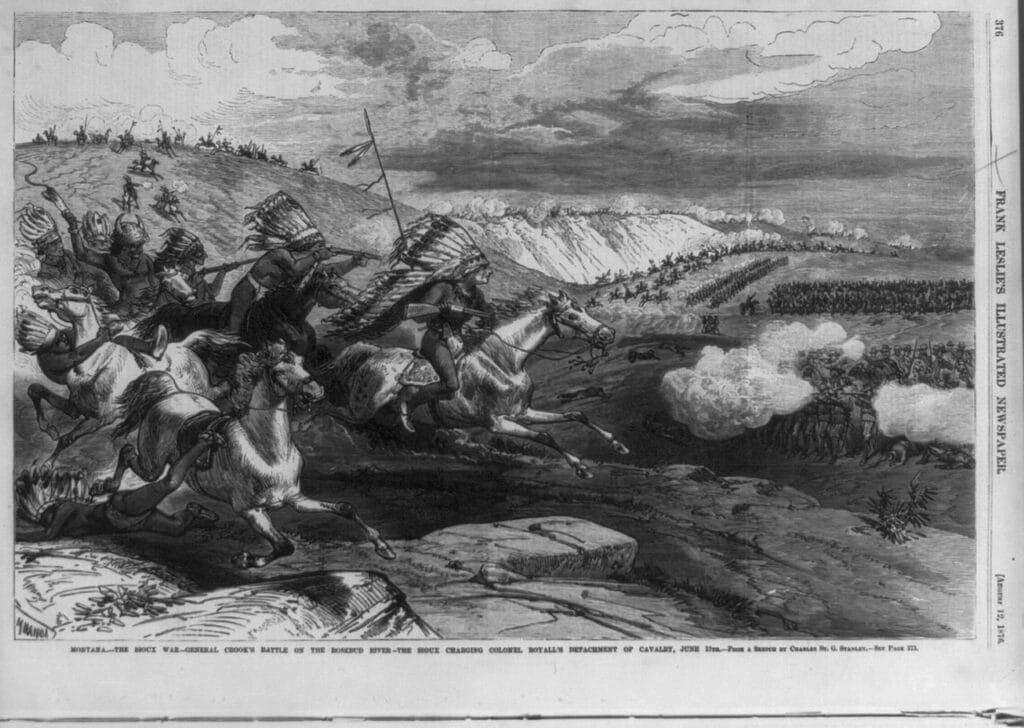
Since General Crook and his men were seen advancing toward their village, warriors prepared to ride out to stop them. Determined to help save her people, Buffalo Calf Road decided to ride with the warriors despite some opposition to a woman doing so.
As the battle raged, she fought bravely. At one point she spotted her brother, Comes In Sight, in a gully below, trapped by soldiers closing in. Immediately, Calf rode down into the gully amidst the flying bullets and, in an amazing rescue, pulled her brother onto her horse and out of the gully to safety.
Those warriors observing the scene were greatly impressed, since they themselves had hesitated, thinking the situation too impossible to save Comes In Sight. Victorious, her people named the battle for her, The Battle Where the Girl Saved Her Brother, and called her Brave Woman.
A week later, General George Armstrong Custer led his troops against an encampment of Cheyenne, Lakota and other tribes camped along the Little Bighorn River. Buffalo Calf Road again joined the warriors and fought bravely for her people, the only woman to do so. During the battle, she rescued a young warrior who lost his horse. Again victorious, the tribes regrouped, each going their own way.
Five months later, the Cheyenne village was viciously attacked again by soldiers in the early morning hours. When it was over, more than 40 Cheyenne lay dead, many wounded, and the village burned to the ground.
Forced to flee again, this time without blankets, adequate clothing or food, Buffalo Calf Road and her people made their way through a freezing, blinding snowstorm that descended on them. That first night in the icy cold, eleven babies froze to death.
The Indians were relentlessly pursued. Slowly, most of the Cheyenne surrendered.
But despite being pregnant, Buffalo Calf Road refused to surrender, holding out with a small group of about 30 Cheyenne “hostiles,” including some children.
During this difficult period of extreme hardship, she had a second child. Eventually, with deteriorating conditions and the army’s promise of land of their own, the small band surrendered, only to learn they would be sent south to what is now Oklahoma.
After a long forced march, they arrived in Indian Territory, to an inhospitable land, an unfamiliar climate, unknown diseases, and a circumscribed life. Conditions were so bad, a group of about 300 Cheyenne, including Buffalo Calf Road and her family, determined to return home.
Escaping during the night, mostly on foot, the band began the harsh journey north. Pursued the whole way by the army, they managed to keep going despite numerous battles with the soldiers dogging them. Again, Buffalo Calf Road fought bravely in defense of her people. Exhausted, hungry much of the time, Calf and her people continued on foot for about 1,500 miles.
After arriving north, the group split in two over a disagreement about how to proceed. One group under Dull Knife headed to Red Cloud’s Lakota village, believing they would be sheltered there. But the army captured and imprisoned them at Fort Robinson, demanding they return south. In despair, deprived of food and water, they broke out of prison on a bitterly cold day, only to be massacred.
Over 65 Cheyenne men, women and children were killed by the soldiers.
The other group, under Chief Little Wolf, included Buffalo Calf Road. They were able to hide for a period in the Sand Hills of Nebraska. Buffalo Calf Road’s husband, meanwhile, had been slowly descending into a kind of madness and killed Black Crane during an argument.
After he was banished, Calf, her children, and a handful of relatives left with him. A short time later, the army captured Little Wolf’s group. Eventually, Buffalo Calf Road’s party was also captured and imprisoned at Fort Keogh, where she died of diphtheria.
She did not live to see her beloved Cheyennes settled on land of their own in 1884 in southeastern Montana, a place known as Lame Deer Reservation.
Sources
Since the Cheyenne were a pre-literate people, there are no diaries or records, only oral accounts of those present at these events. So Buffalo Calf Road is known only through oral history accounts of Cheyenne contemporaries, especially two women, Kate Big Head and Iron Teeth who tell of her exploits in interviews.
We also have the work of Mari Sandoz who writes of the flight north from Indian Territory based on her interviews of women who were present, especially Old Cheyenne Woman. Most of the men who fought with Buffalo Calf Road failed to mention her exploits with the notable exception of Wooden Leg, a warrior who fought with her. He told of her heroic acts, providing a detailed account of her in battle and during the period when she gave birth, before the small band of 30 surrendered.
There are no photos of her, but there are two ledger book sketches: Yellow Nose depicts her saving her brother in battle and Amos Bad Heart Bull draws her riding into battle with her brother.
Buffalo Calf Road Woman: The Book
Buffalo Calf Road Woman: The Story of a Warrior of the Little Bighorn, by Rosemary Agonito and researched by Joseph Agonito, won the prestigious 2006 Western Heritage Award for Best Western Novel.
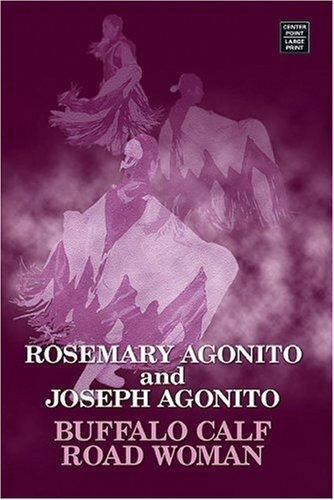

Rosemary Agonito is the author of the award-winning book Buffalo Calf Road Woman: The Story of a Warrior of the Little Bighorn, which won the prestigious 2006 Western Heritage Award for Best Western Novel.

Fascinating article. Thanks.for sharing. Heartbreaking. This will haunt me …
All The Kick Ass Women The History Books Left Out Is Right…We Women Have Been kicking Ass For Centuries & It’s Thanks To Buffalo Calf Road & The Rest Of The Brave Warrior Women That Dared To Blaze One Helluva’ Trail That We Follow With Great Pride. Buffalo Calf Road Had The Balls That Men Lack Especially In This Era…Her As Her Spirit Is Still Very Much Alive In Each & Every One Of All Kick Ass Women & Rosemary Agonito You Kick Ass For Giving Voice To This Kick Ass Warrior Woman’s Bravery & Allowing Us Modern Day Warrior Women… More Importantly The Future Generations Of Warrior Women To Know Her Story…Amen Sister
I’ve been starting to research women in the west. This is a fascinating story. Thanks for highlighting it. I’ll definitely check out the book, too.
The biography noted here on the AWH site is of course short but very factual.
I have heard that the book is a fictionalized version of Buffalo Calf Roads life. It’s goes so far as to surmise that she actually may have been the warrior that dealt the final blow to Custer.
This makes for a good read of course but history should be told as it happened not by assumptions.
The book is VERY true to real life. It was meticulously researched by a historian who specializes in the Native Americans of the Plains. All events are true as the Northern Cheyenne people lived it. BCR’s story is based on the accounts of the Cheyenne women and men who shared these events with her. It is a fictionalized version because it tells the story with daily interactions and conversation that are fictionalized since we have no way of knowing what was actually said or done in an ordinary day. This brings the story to life. But as history the story and events are true.
EXCELLENT!!!!!!! Thank-You so much for clarifying this!!! I was married to the great-great grandson of General Crook. Whom was married to a Native American woman. She taught him so much!! He healed himself 3 times of cancer, with homeopathics used by her tribe. What a RICH culture the Native folk are and were. I have the utmost respect and admiration for the Native folk. Blessings to ALL.
If there are no pictures of her. Then who is the picture of in the article? I love these stories of amazing women!!! Thank you for sharing this.