
Throughout history, women have made groundbreaking contributions to science, often overcoming significant barriers and discrimination. Despite facing exclusion from universities, research institutions, and professional recognition, these remarkable women persevered and made discoveries that changed our understanding of the world. Their dedication to scientific inquiry paved the way for future generations of female scientists and left an indelible mark on human knowledge.
1. Marie Curie (1867 – 1934)

Marie Curie stands as perhaps the most famous female scientist in history, and for good reason. Born Maria Skłodowska in Warsaw, Poland, she overcame tremendous obstacles to become the first woman to win a Nobel Prize and the only person to win Nobel Prizes in two different scientific fields.
Curie moved to Paris in 1891 to study at the Sorbonne, where she earned degrees in physics and mathematics. Her groundbreaking research on radioactivity, a term she coined, led to the discovery of two new elements: polonium and radium. Her work fundamentally changed our understanding of atomic structure and laid the foundation for modern atomic physics.
In 1903, Marie Curie shared the Nobel Prize in Physics with her husband Pierre and Henri Becquerel for their work on radioactivity. After Pierre’s tragic death in 1906, she continued their research and won a second Nobel Prize in Chemistry in 1911 for her discovery of radium and polonium.
Despite facing discrimination as both a woman and a foreigner in France, Curie became the first female professor at the University of Paris. Her dedication to science came at a personal cost, since her prolonged exposure to radiation eventually led to her death from aplastic anemia in 1934.
See: 5 Famous Women Atheists In History
2. Nettie Stevens (1861 – 1912)
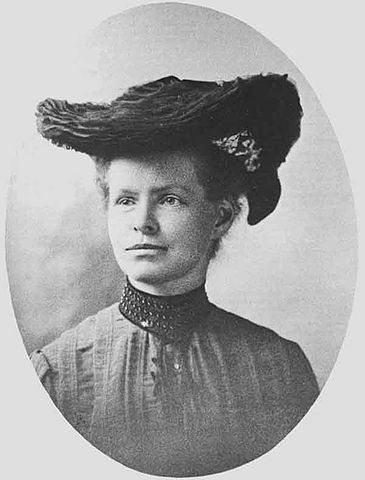
At the start of the 20th century, Nettie Stevens was working to solve a scientific problem that had troubled humanity for ages. The problem was simple but daunting and it touched on how men become male and how women become female. Through her research work, biologist Stevens discovered that chromosomes are responsible for the sex of individuals, animals and every other living organism.
Born in 1861 in Vermont, Nettie Stevens was passionate about science from an early age. She worked as a teacher after graduating high school but at the back of her mind she knew that was not what she was destined to do.
She saved money from her teaching profession and enrolled into Stanford University at the age of 35 to do what she always dreamt of doing which is to study science. She excelled as a science student and graduated top of her class with a B.A in 1899. She did her M.A a year later.
She then joined Bryn Mawr College in Pennsylvania and it is here where she worked to solve the problem of sex determination. The theory that chromosomes bore hereditary information was relatively new in early 1900 and the science world was trying to determine how character traits like the biological sex of an individual were passed down across generations.
Stevens was working on the mealworm beetle as she sought to find out if sex was genetically inherited. When observing the female mealworm beetle, she found that her sex cells had 20 large chromosomes. The male also had 20 chromosomes but only 19 were large and the 20th was small.
She concluded that the difference in either male or female offspring was down to the sperm of the male beetle. If the sperm contained the smaller 20th chromosome, then the offspring would be male and if the sperm contained the large chromosome, the offspring would be female.
Stevens started her career in science very late and it was quite unfortunate that it ended early as well. After her discovery on sex chromosomes, Stevens continued her research work at Bryn Mawr College and received her Ph.D. in 1905. She worked as an assistant professor at the college until her death in 1912.
Breast cancer was what caused her death and it is quite unfortunate that it robbed the world of a distinguished research fellow who made the biggest discovery in the world of genetics.
3. Rosalind Franklin (1920 – 1958)

Rosalind Franklin was a British chemist whose pioneering work in X-ray crystallography was crucial to understanding the structure of DNA. Born in London to a well-connected family, Franklin excelled academically from an early age and earned her Ph.D. in physical chemistry from Cambridge University in 1945.
Franklin’s most significant contribution came through her work at King’s College London, where she used X-ray crystallography to study the structure of DNA. Her famous “Photo 51” provided critical evidence that DNA had a helical structure. This photograph, along with her meticulous measurements and calculations, was instrumental in determining that DNA was a double helix.
Tragically, Franklin’s work was shared with James Watson and Francis Crick without her knowledge. Watson and Crick used her data to construct their model of DNA structure, for which they received the Nobel Prize in 1962. Franklin had died four years earlier from ovarian cancer at the age of 37, likely caused by her extensive exposure to X-rays during her research.
Beyond DNA, Franklin made important contributions to understanding the structure of RNA and viruses. Her work on the tobacco mosaic virus and polio virus advanced our knowledge of how viruses are constructed and function.
See: The Matilda Effect: Invisible Women in Science
4. Barbara McClintock (1902 – 1992)

Barbara McClintock was an American geneticist who made revolutionary discoveries about how genes work, though her groundbreaking research was initially dismissed by the scientific community. Born in Connecticut, McClintock earned her Ph.D. in botany from Cornell University in 1927 and began her career studying corn genetics.
McClintock’s most significant discovery was that genes could move within chromosomes, a concept she called “genetic transposition.” Working with corn plants in the 1940s and 1950s, she observed that certain genetic elements could change position on chromosomes, affecting the expression of other genes. This discovery challenged the prevailing belief that genes were fixed in their chromosomal locations.
Her work was so far ahead of its time that the scientific community largely ignored or rejected her findings for decades. It wasn’t until the 1970s, when molecular biology techniques confirmed her observations, that McClintock received recognition for her pioneering work.
In 1983, at the age of 81, McClintock was awarded the Nobel Prize in Physiology or Medicine for her discovery of genetic transposition. Her “jumping genes” are now known to play crucial roles in evolution, genetic regulation, and even in the development of cancer.
5. Dorothy Hodgkin (1910 – 1994)

Dorothy Hodgkin was a British chemist who pioneered the use of X-ray crystallography to determine the structures of important biological molecules. Born in Cairo to British parents, Hodgkin developed an early interest in chemistry and crystals, which would define her entire career.
Hodgkin earned her Ph.D. from Cambridge University and later worked at Oxford University, where she spent most of her career. She used X-ray crystallography—a technique that analyzes how X-rays scatter when they hit crystals—to determine the three-dimensional structures of complex molecules.
Her most famous achievements include determining the structure of penicillin during World War II, which was crucial for mass-producing this life-saving antibiotic. She also worked out the structure of vitamin B12, a complex molecule with over 100 atoms, which was an extraordinary feat given the technology available at the time.
In 1964, Hodgkin became the third woman to win the Nobel Prize in Chemistry for her work on the structures of important biological molecules. Later in her career, she successfully determined the structure of insulin, a project that took her over 30 years to complete.
Throughout her career, Hodgkin mentored many young scientists and was known for her kindness and encouragement. She broke barriers not only through her scientific achievements but also by showing that women could excel in the demanding field of structural chemistry.
These five women represent just a fraction of the countless female scientists who have advanced human knowledge despite facing significant obstacles. Their perseverance, brilliance, and dedication continue to inspire scientists today and remind us that scientific progress depends on diverse perspectives and unwavering curiosity about the natural world.
Citations
- Curie, Marie. Pierre Curie. Translated by Charlotte and Vernon Kellogg. New York: Macmillan, 1923.
- Franklin, Rosalind, and R. G. Gosling. “Molecular Configuration in Sodium Thymonucleate.” Nature 171, no. 4356 (1953): 740-741.
- Hodgkin, Dorothy. “The X-ray Analysis of Complicated Molecules.” Science 150, no. 3696 (1965): 979-988.
- Keller, Evelyn Fox. A Feeling for the Organism: The Life and Work of Barbara McClintock. New York: W. H. Freeman, 1983.
- McClintock, Barbara. “The Origin and Behavior of Mutable Loci in Maize.” Proceedings of the National Academy of Sciences 36, no. 6 (1950): 344-355.
- Maddox, Brenda. Rosalind Franklin: The Dark Lady of DNA. New York: HarperCollins, 2002.
- Ogilvie, Marilyn Bailey, and Joy Dorothy Harvey, eds. The Biographical Dictionary of Women in Science: Pioneering Lives from Ancient Times to the Mid-20th Century. New York: Routledge, 2000.
- Stevens, Nettie Maria. “Studies in Spermatogenesis with Especial Reference to the Accessory Chromosome.” Carnegie Institution of Washington Publication 36 (1905): 1-32.

Keri is a blogger and digital marketing professional who founded Amazing Women In History in 2011.

Leave a Reply