

Aphra Behn was one of the most successful playwrights in 17th century London, bringing bold, witty women to the stage and publishing poetry under her own name. She was also a pioneer among English women who earned a living by writing, and she refused to apologize for wanting both money and fame. Before any of that, she’d worked as a spy for Charles II. Her literary career gave her the fame and success she sought, and she wasn’t about to let her critics have the last word.
Astrea’s Secret Mission
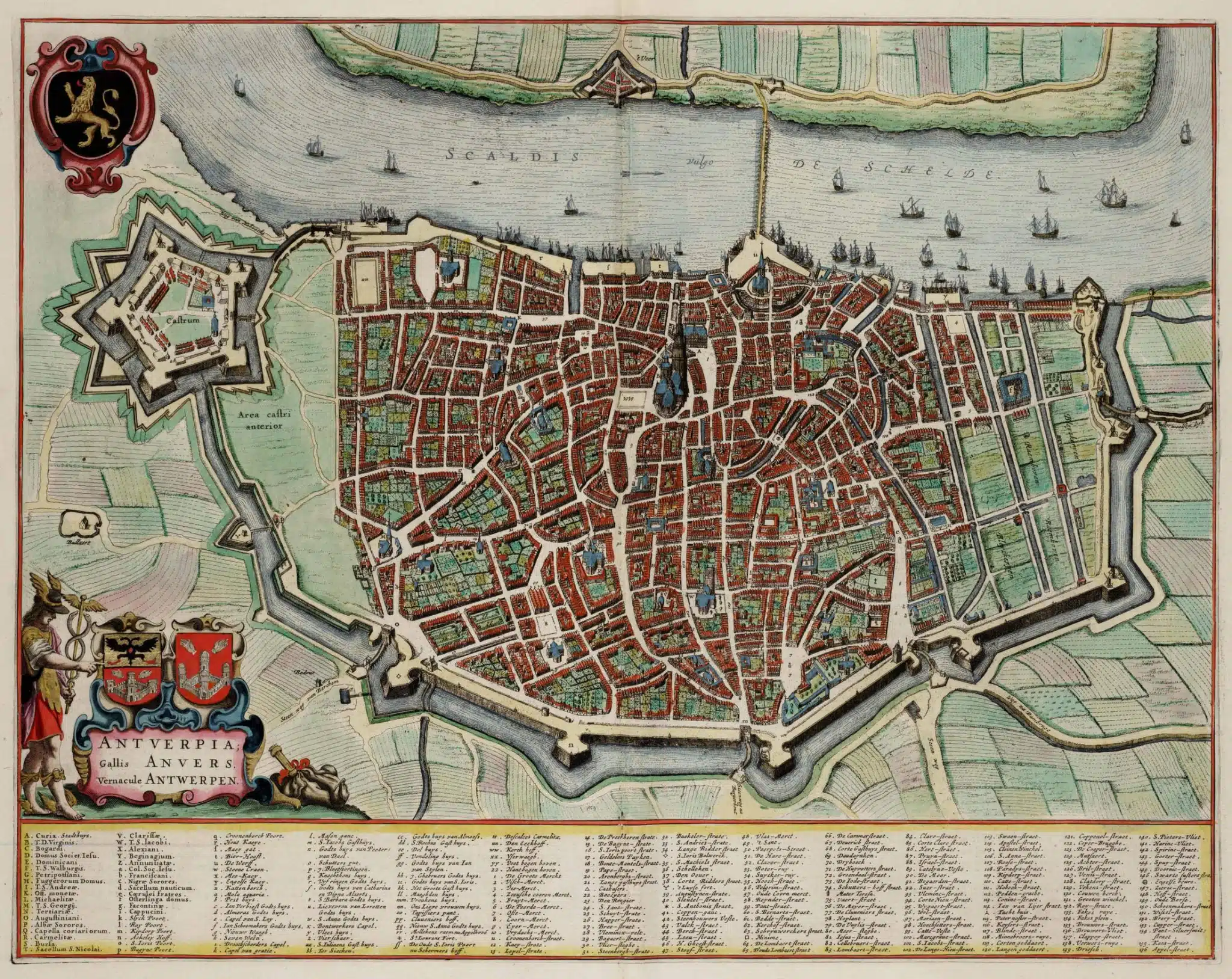
In 1666, England was at war with the Dutch Republic. Behn traveled to Antwerp, in present-day Belgium, on an intelligence mission for Charles II’s government. Her code name was Astrea.
Her assignment included recruiting William Scot, an English exile working with the Dutch. Through him, the English government hoped to learn about Dutch ships and the activities of English exiles abroad. Behn was to offer him a pardon and a reward in exchange for information.
She contacted Scot and sent reports back to England. But the operation depended on promises she couldn’t fulfill by herself. In a letter to Lord Arlington, the English secretary of state, Behn complained that she had received no answers to her reports. Without the promised help, Scot couldn’t make the journeys needed to collect information. Worse, he was losing faith in her assurances.
Behn was running out of money herself. In the same letter, dated November 3, she described pawning her rings to help Scot and borrowing to keep going. A payment of £50 had finally been sent, but by then she owed £120. The payment was worth only £46 when it reached her, so she borrowed again to put the full £50 toward her debts.
She asked Arlington to have her debts paid and help her get home. Otherwise, she warned, the people she owed could have her arrested.
Behn eventually returned to England with the help of another loan. The mission had left her in debt, and threats of imprisonment followed her home, but there is no firm evidence that she was actually jailed.
Earning Her Living in the Theater
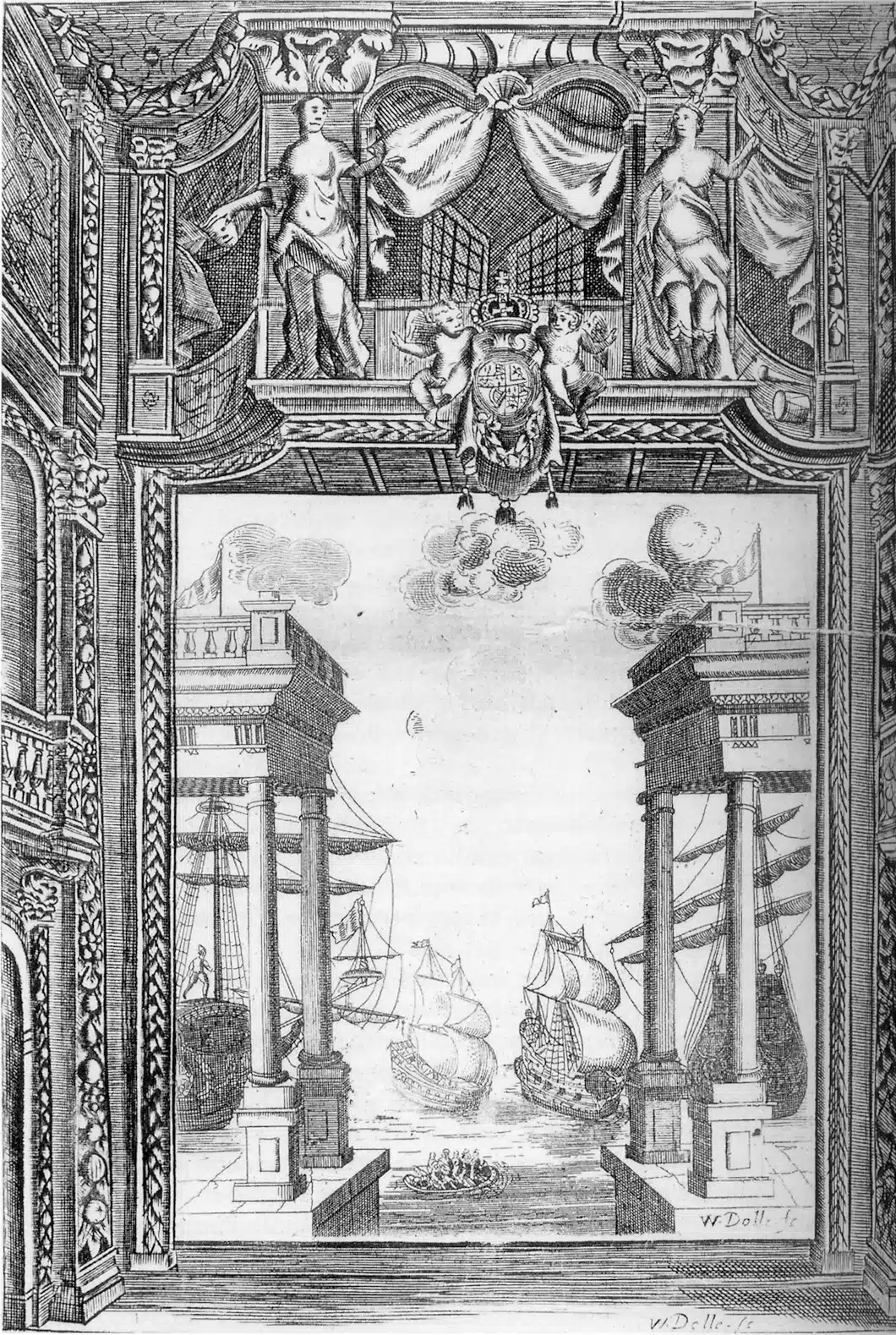
By September 1670, Behn had a different kind of work before the public. The Duke’s Company, a London theater troupe, staged her play The Forc’d Marriage. It was published the following year.
London’s theaters had reopened after Charles II returned to the throne in 1660, ending the long closure imposed during the English Civil War. Behn entered a revived theatrical world where companies needed plays and audiences paid to see them.
The author generally received the takings from the third performance, after the theater’s expenses had been deducted. A crowded house could mean a useful payment. A play that closed before its third night could leave its author without any income from the performances.
In addition to performances, selling a play for publication offered another way to earn money and reach readers. This was a separate deal with a bookseller, who paid for the right to print and sell the script. More than a dozen of Behn’s plays were published during her lifetime.
Audiences often saw her plays before readers could buy them. The timing varied: The Forc’d Marriage was printed the year after its first performance, while The Rover was both staged and published in 1677. In the printed editions, Behn could also add a preface addressed to readers, answering any criticism the play had received onstage.
She continued supplying the theater with new plays through the 1670s, building a career in a trade overwhelmingly dominated by men.
The Rover Makes Her Name
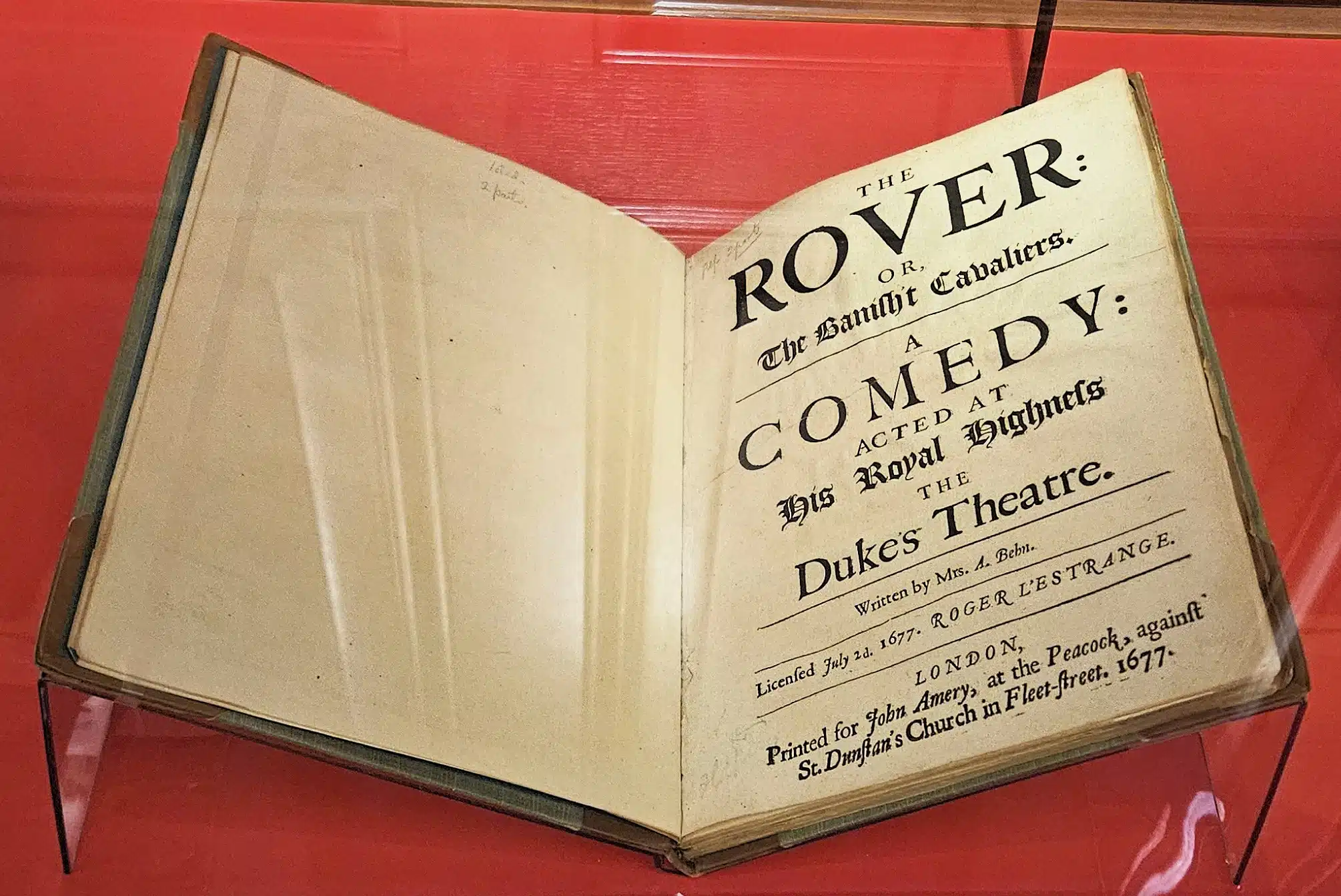
Behn scored a major success with her play The Rover in 1677. Set in Naples during Carnival, the comedy follows English travelers and the women they meet amid disguises, flirtation, and dangerous misunderstandings.
One of those women is Hellena, whose family intends to send her to a convent. Hellena has other plans. Before being shut away, she wants to find out what it’s like to fall in love.
Carnival, a season of festivities and disguises before the Christian fast of Lent, gives her an opportunity. Disguised, she can go out and speak to men without immediately revealing who she is. She meets Willmore, an Englishman with a ready supply of charm and very little interest in staying faithful to anyone.
Hellena can match him in an argument. When he tries to persuade her to become his lover without marriage, she refuses. She wants him, but she also wants a wedding, and she won’t accept all the risks of their relationship herself. By the end of the play, Willmore agrees to marry her.
Behn gave Hellena the wit and determination to bargain for a future her family hadn’t chosen for her. The marriage agreement doesn’t turn Willmore into a trustworthy man, but Hellena has made her own choice and insisted on terms.
Writing sexual comedy also gave Behn’s critics plenty to attack. Her comedy Sir Patient Fancy was first performed in January 1678. Some theatergoers objected to its sexual content. According to Behn, women were among those condemning it.
She hurried the play into print that same year so she could answer them. Her reply was a prose introduction titled “To the Reader,” printed before the play.
Behn argued that her sex was the real offense in her critics’ eyes. Male playwrights could write material that audiences accepted, while comparable writing from a woman was treated as unnatural. She also answered anyone who thought writing for money was beneath her: she was “forced to write for Bread and not ashamed to owne it.”
Her Poetry Reaches Readers
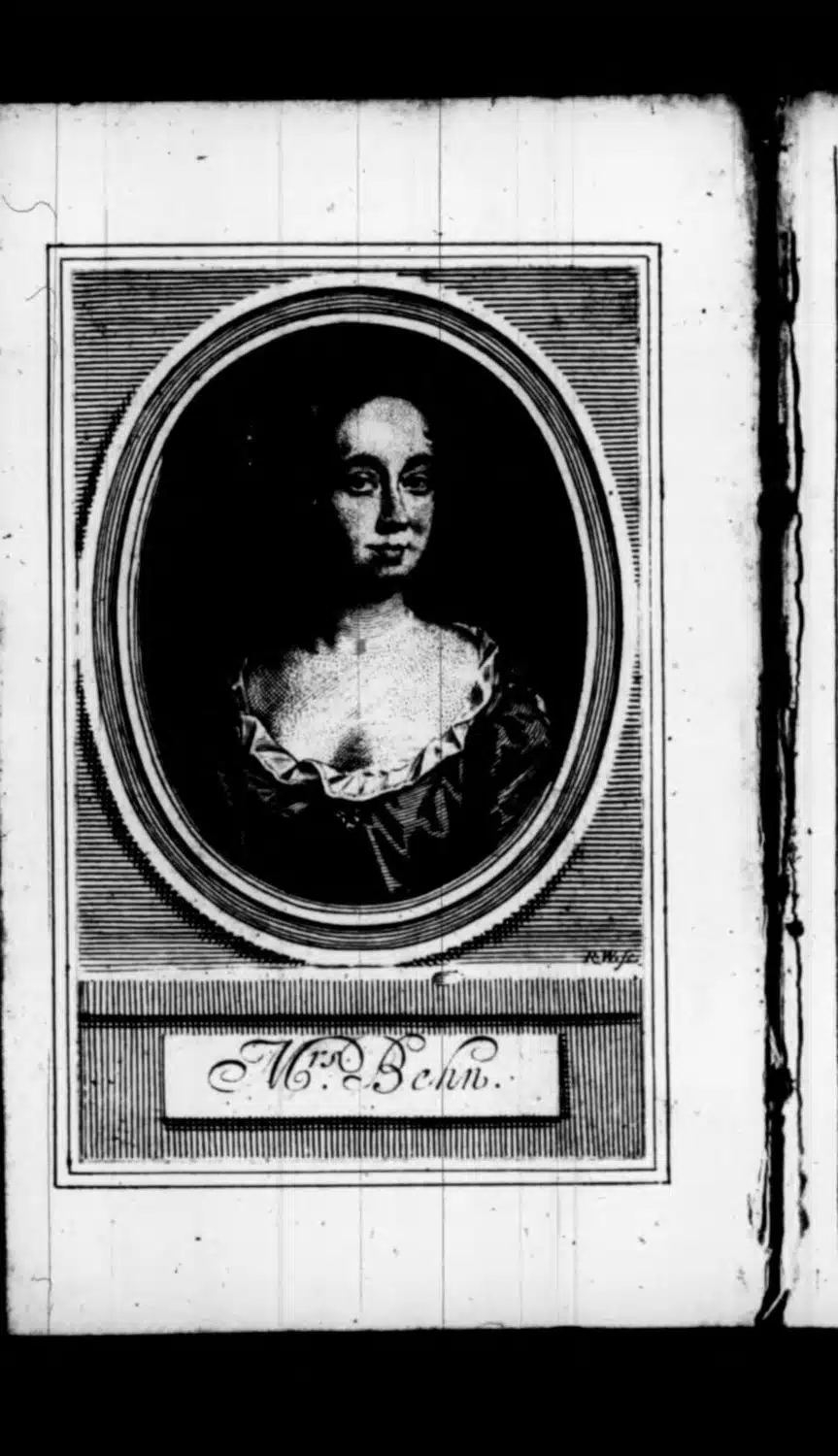
Behn published Poems upon Several Occasions in 1684. The volume brought together her poetry alongside A Voyage to the Isle of Love, her translation of a French poem. The London booksellers R. Tonson and J. Tonson issued the collection under her name.
Her poems included love songs, praise, grief, and arguments about the unequal power of lovers.
Here’s “Love Arm’d” in full, with its original spelling:
Love in Fantastique Triumph satt,
Whilst Bleeding Hearts a round him flow’d,
For whom Fresh paines he did Create,
And strange Tryanick power he show’d;
From thy Bright Eyes he took his fire,
Which round about, in sport he hurl’d;
But ’twas from mine he took desire,
Enough to undo the Amorous World.
From me he took his sighs and tears,
From thee his Pride and Crueltie;
From me his Languishments and Feares,
And every Killing Dart from thee;
Thus thou and I, the God have arm’d,
And sett him up a Deity;
But my poor Heart alone is harm’d,
Whilst thine the Victor is, and free.
The collection also opened with poems by other writers praising Behn’s work. Before reaching her own poems, readers encountered tributes to her wit and skill. She had plenty of fellow writers willing to celebrate her achievements.
Behn Demands Recognition
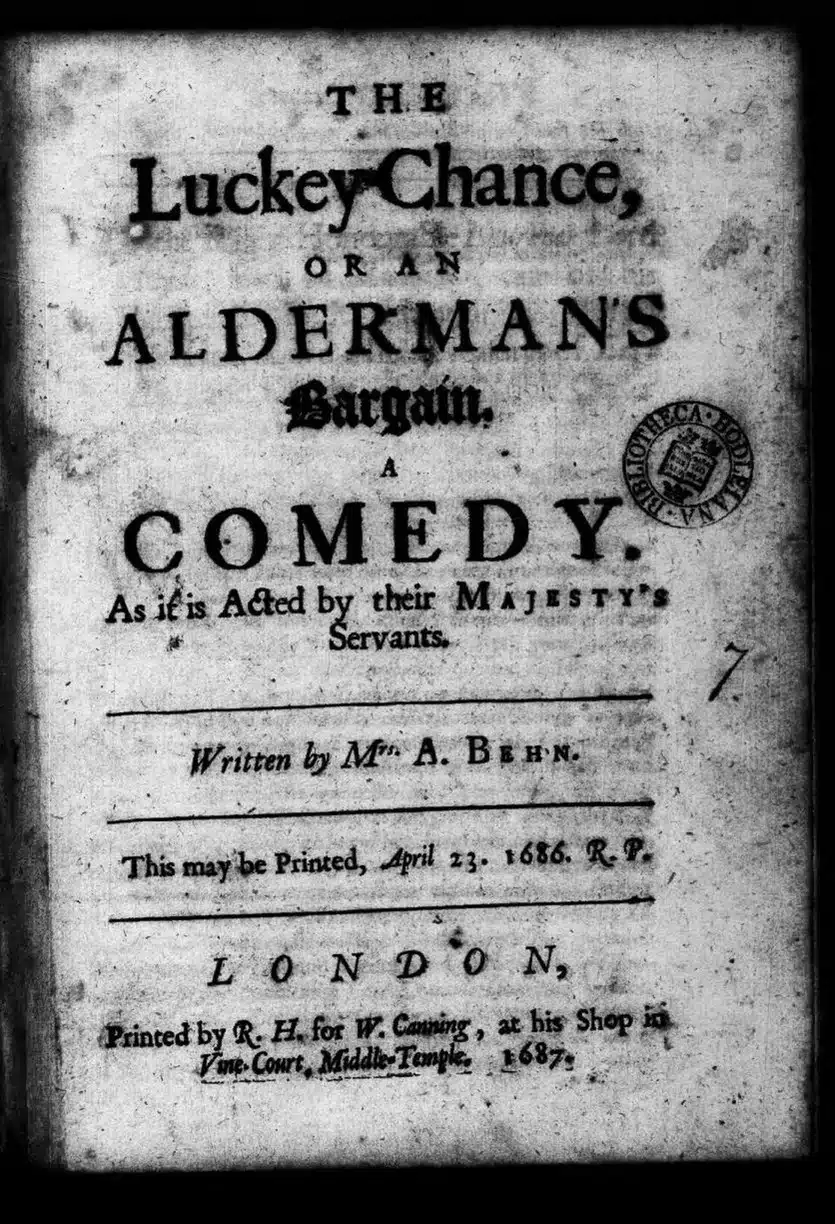
Her willingness to write frankly about sex and marriage continued to provoke objections. In The Lucky Chance, first performed in 1686, one husband gambles with his wife’s former suitor and agrees to let him spend a night with her. A woman’s body becomes part of a bargain between men.
The performances drew accusations of obscenity, which Behn answered in the preface when the play was published in 1687. She refused to let hostile voices stand for the whole audience. Women had read and approved the script before it was staged, she wrote, and others had enjoyed seeing it more than once. She also pointed to the money it had brought in as evidence that audiences hadn’t found it so outrageous.
Behn didn’t let the critics slow her down. Her comedy The Emperor of the Moon reached the stage in 1687, and she also continued writing prose. She died on April 16, 1689, at about 48 years old.
In her defense of The Lucky Chance, she’d made clear that a third night’s earnings weren’t the limit of her ambition.
I value Fame as much as if I had been born a Hero
Aphra Behn, preface to The Lucky Chance (1687)
Her work found audiences long after her death. In 2016, more than three centuries after she wrote The Rover, the Royal Shakespeare Company staged it at the Swan Theatre.
Sources and Further Reading
- Aphra Behn, letter to Lord Arlington, November 3, 1666. Oxford Taylor Editions; manuscript at The National Archives, SP 29/177, fols. 51r–52v.
- Mary Ann O’Donnell, “Aphra Behn: the documentary record,” in The Cambridge Companion to Aphra Behn (2004), publisher’s excerpt.
- Catherine Gallagher, Nobody’s Story (1994), chapter 1, especially pp. 9–14, on writing and theatrical income.
- Aphra Behn, The Rover, Acts I and V, in Works, vol. I; Sir Patient Fancy, “To the Reader,” in Works, vol. IV.
- Aphra Behn, Poems upon Several Occasions, in Works, vol. VI. “Love Arm’d,” pp. 163–164.
- Aphra Behn, The Lucky Chance, preface, in Works, vol. III, pp. 185–187.
- Cambridge University Press, “Publick Pleasures and Divertisements: Aphra Behn’s Late Plays” (2021).
- Westminster Abbey, “Aphra Behn.”
- Deborah C. Payne, “Fame and Famine,” The Business of English Restoration Theatre, 1660–1700 (2024), section “The Palliative of Print.”
- The Cambridge Companion to Aphra Behn (2004), chronology of performances and publications.
- Fowler Museum at UCLA, “¡Carnaval!”
- Royal Shakespeare Company, The Rover, 2016 production.

Beyond the article
Join the Conversation
Share your perspective, ask a question, or add something to the story.