
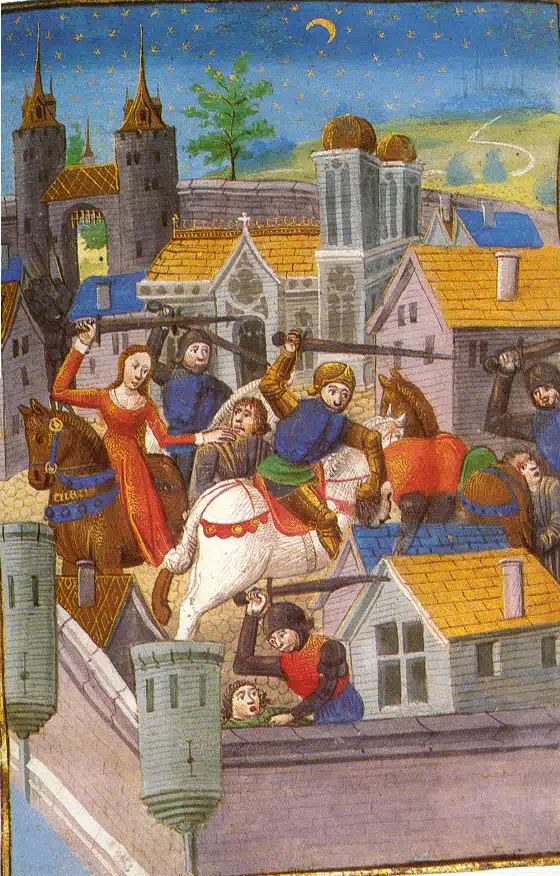
When we imagine the Middle Ages, our minds almost immediately summon a specific image: a heavily armored man astride a warhorse, charging into battle to defend a kingdom or rescue a damsel in distress. Centuries of popular culture, literature, and romanticized history have taught us that chivalry was exclusively a man’s game.
Yet history tells a far more surprising story.
While female knights were undeniably rare in medieval Europe, they were not a myth. Women took up arms, commanded troops, and were officially inducted into prestige chivalric orders, receiving the same titles, privileges, and honors as their male counterparts.
Medieval Chivalry: A World Reserved for Men?
The Middle Ages (the vast period of European history spanning from the fall of the Western Roman Empire in the 5th century to the dawn of the Renaissance in the 15th century) was governed by strict feudal hierarchies and rigid gender roles.
During this era, a knight was a mounted warrior of noble rank. Knights were expected to master equestrian combat, swear fealty to a lord, and live by a strict moral code known as chivalry.
Under mainstream medieval law, women were mostly expected to remain within the domestic sphere, managing estates or religious houses rather than riding onto the battlefield. (It IS also true that “medieval law” was complex and not a monolith, and that there were plenty of exceptions to this generalization.)
However, the harsh realities of medieval warfare routinely tore these theoretical boundaries apart. When armies laid siege to towns, when husbands died on crusade, or when territories faced total destruction, women stepped into the breach.
Different chivalric orders throughout Europe established their own rules, and a select few formally recognized that bravery, martial skill, and honor were not restricted to men:
| Order | Founding Year | Location | Title |
|---|---|---|---|
| Order of the Hatchet | 1149 | Tortosa, Spain | Cavalleria |
| Order of the Blessed Virgin | 1261 | Italy | Militissa |
| Order of the Garter | 1348 | England | Lady of the Garter |
| [French Feudal Custom] | Late Middle Ages | France | Chevaleresse |
Let’s take a look at a few of these traditions.
Spain’s Order of the Hatchet: The Warrior Women of Tortosa
One of the most remarkable examples of military knighthood bestowed upon women occurred in 12th-century Spain.
In 1149, the city of Tortosa was recovering from recent crusader battles when an enemy army launched a surprise siege against the town. With the local military forces depleted, the Earl of the town saw no path forward and prepared to surrender.
The women of Tortosa flatly refused to give up their homes to destruction.
Rejecting the Earl’s surrender, the women donned men’s armor, grabbed whatever weapons they could find (most notably battle-axes) and launched a fierce counterattack against the besieging army. Fighting with desperate ferocity, they drove the enemy away and lifted the siege entirely on their own.
In recognition of their extraordinary heroism, Raymond Berenguer IV, the Count of Barcelona, established the Order of the Hatchet (Orden de la Hacha).
The women who fought were granted full knightly status, along with unprecedented legal privileges:
- Exemption from paying taxes on their goods.
- Precedence over men at all public assemblies and town meetings.
- The right to wear special knightly robes bearing the emblem of a red hatchet.
Their titles and privileges were hereditary, passing down through their daughters, a powerful historical reminder that these women earned their honor through blood and courage on the battlefield.
French Chevaleresses: Distinguishing Wives from Female Warriors
Language itself offers a fascinating window into the historical reality of female knighthood. In Old French, the standard word for a male knight is chevalier. Medieval French contained two distinct feminine variations of this word, which served very different social functions:
- Chevalière: Used primarily as a courtesy title for the wife of a male knight.
- Chevaleresse: Reserved for women who held knightly rank in their own right.
As one 17th-century scholar writing on the history of chivalry observed:
“Sometimes, when some male fiefs were conceded by special privilege to women, they took the rank of chevaleresse, as one sees plainly in Hemricourt where women who were not wives of knights are called chevaleresses.”
These chevaleresses held land by military tenure, meaning they were legally bound to provide military service or lead troops when called upon. They were not merely wives enjoying an inherited honorary title; they were recognized as individual feudal leaders within the knightly class.
England’s Most Noble Order of the Garter
In England, King Edward III founded the Most Noble Order of the Garter in 1348. It stands today as the oldest and most prestigious chivalric order in the United Kingdom, strictly limited to no more than 24 companion members at any given time.
What many modern observers do not realize is that the medieval Order of the Garter regularly honored women.
Between 1358 and 1488, 68 women were formally appointed as Ladies of the Garter.
While many of these inductees were royal princesses or high-ranking noblewomen, several appointments were granted to women who belonged to neither royal nor diplomatic circles.
These women were awarded the order’s distinctive garter robes and insignia based on their personal contributions, service to the Crown, and individual merits.
Though the practice of inducting women lapsed during the Tudor era, it was formally revived in the 20th century, cementing the long historical lineage of female companions within Britain’s highest order of chivalry.
Italy’s Order of the Blessed Virgin Mary: The Militissa
In 1261, a military order known as the Order of the Blessed Virgin Mary was established in northern Italy. Unlike strictly male monastic orders, this military order was unique in granting women full formal membership under the official Latin title of militissa (the feminine form of miles, the Latin word for soldier or knight).
The women of the order held recognized religious and social rank, dedicated to keeping peace between warring political factions and protecting widows and orphans.
Unfortunately, the order’s leadership eventually drifted from its original noble purpose. Due to widespread corruption, extravagance, and negligence among its male leadership, the group earned the mocking Latin nickname fratres gaudentes (“jovial brothers”).
Despite its eventual suppression by Pope Sixtus V in 1558, the order’s historical charters remain clear evidence that 13th-century religious military organizations formally created ranks for female knights.
The Enduring Legacy of Chivalric Women
History is often written by those who prefer simple narratives, and for centuries, the contributions of medieval women were intentionally minimized or forgotten.
Yet the historical record remains clear: when duty called, medieval women commanded garrisons, defended besieged cities, led armies, and earned membership in elite chivalric orders.
The women of Tortosa, the French chevaleresses, and the militissa of Italy proved that courage, leadership, and martial skill were not limited by gender. Their legacies continue to inspire us today, reminding us that even in eras defined by severe limitations, extraordinary women found ways to break the mold and carve their names into history.
Recommended Reading
- Ana Nzinga Mbande, fearless African queen
- Buffalo Calf Road, Heroic Cheyenne Warrior Woman
- Cathay Williams, AKA William Cathay, American Civil War soldier
- Lin Siniang: Marshalling Spear and Sword
- Sayyida al Hurra, Islamic pirate queen
- The Warrior Queen Chand Bibi
- Trieu Thi Trinh, the Vietnamese Joan of Arc
Sources & References
- Barber, Richard. The Knight and Chivalry. Boydell Press, 1996.
- Bennett, Judith M. Medieval Women in Modern Perspective. American Historical Association, 2000.
- Vernier, Richard. The Flower of Chivalry: Bertrand du Guesclin and the Hundred Years War. Boydell Press, 2003. (Discusses French chevaleresses and military tenure).

Keri is a blogger and digital marketing professional who founded Amazing Women In History in 2011.
Beyond the article
Join the Conversation
Share your perspective, ask a question, or add something to the story.